
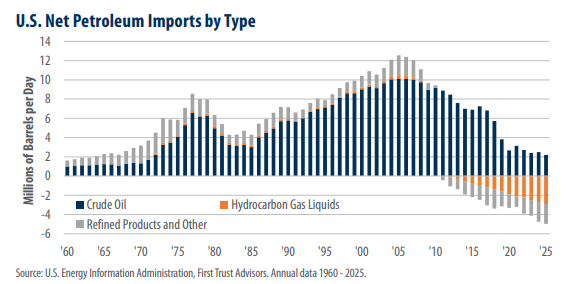
The United States has undergone one of the most dramatic energy transformations in modern history. Just two decades ago, the country was importing more than 12 million barrels per day (bpd) of petroleum on net. Today, thanks to the shale revolution, America is a net exporter of petroleum, a status it has maintained since 2020.
A compelling chart from First Trust Advisors illustrates this shift vividly, breaking down U.S. net petroleum imports by type (crude oil, hydrocarbon gas liquids, and refined products) from 1960 through 2025. The visual tells the story of declining dependence, surging domestic production, and America’s emergence as a global refining powerhouse.
The Dramatic Turnaround in U.S. Oil Imports
At its peak in the mid-2000s, U.S. net petroleum imports exceeded 12 million bpd, raising serious concerns about energy security and vulnerability to foreign supply disruptions. The shale revolution, driven by advances in hydraulic fracturing (fracking) and horizontal drilling changed everything.
- Crude Oil: The U.S. remains a net importer of crude (approximately 2.2 million bpd in 2025, down sharply from peaks near 10 million bpd), but imports have plunged. Much of this crude complement’s domestic light shale oil in complex U.S. refineries.
- Refined Products: America imports crude, refines it into gasoline, diesel, and jet fuel, and exports massive volumes, establishing itself as a leading global supplier of finished petroleum products.
- Hydrocarbon Gas Liquids: These have flipped strongly into net export territory amid booming natural gas production.
By 2025, the U.S. exported roughly 10.7 million bpd versus 7.9 million bpd imported, maintaining a healthy net export position of about 2.8 million bpd.
Long-Term Impacts of the Shale Revolution
- Enhanced Energy Security and Geopolitical Leverage
Reduced reliance on imported oil, particularly from volatile regions, has strengthened U.S. national security. Disruptions in the Middle East, such as the recent closure of the Strait of Hormuz now have a more muted direct impact on American consumers and policymakers than years past. This “energy independence”, or more accurately, energy dominance, gives the U.S. greater strategic flexibility in foreign policy.
- Economic Benefits
- Trade Balance: Net exports improve the U.S. current account and reduce dollars flowing overseas.
- Jobs and Growth: The shale boom created hundreds of thousands of direct and indirect jobs, boosted local economies in producing states (Texas, North Dakota, Pennsylvania, etc.), and delivered lower energy prices that benefited consumers and manufacturers.
- Refining Hub Advantage: The U.S. leverages the world’s largest and most sophisticated refining capacity to add value domestically and export high-value products globally.
Lower energy prices from increased supply have saved American households significant amounts annually, with disproportionate benefits for lower-income families.
- Global Market Influence
The U.S. is now one of the world’s top oil and gas producers and exporters. This has diversified global supply, helped moderate world oil prices at times, and challenged traditional producers like OPEC. American LNG and refined product exports are reshaping energy flows, particularly in Europe and Asia.
- Environmental and Sustainability Considerations
While shale has displaced some coal-fired power generation, the industry faces ongoing challenges around methane emissions, water use, and seismic activity. Future growth will likely depend on technological improvements, regulatory frameworks, and the pace of the energy transition.
Future Outlook: Sustaining the Advantage
U.S. crude production hit record levels in 2025 (around 13.6 million bpd), and the country is expected to remain a net petroleum exporter for years to come. However, challenges include:
- Decline Rates: Shale wells produce at high initial rates but decline rapidly, requiring continuous drilling and investment.
- Infrastructure and Policy: Pipeline capacity, export terminals, permitting reform, and access to federal lands will influence long-term output.
- Global Demand and Competition: The rise of electric vehicles, renewables, and efficiency gains could moderate demand, while international rivals expand their own unconventional resources.
- Capital Discipline: Operators are focusing more on returns than sheer volume growth.
Projections suggest U.S. production will remain robust through 2040 and beyond, though growth rates may moderate.
Powering the AI Revolution – The Shale Legacy and the Urgent Need for Energy Expansion
The shale revolution that transformed U.S. petroleum trade balances is now proving even more critical as America confronts a new surge in energy demand driven by artificial intelligence. Data centers powering AI training and inference are among the most electricity-intensive operations in history, and their explosive growth is reshaping the nation’s power outlook.
According to recent projections, U.S. data centers consumed roughly 4% of total electricity in recent years. By 2030, this share is expected to rise significantly, potentially reaching 8-12% or higher in some forecasts, with AI-optimized servers accounting for a rapidly growing portion of that load. Electricity demand from data centers could more than double nationally, adding hundreds of terawatt-hours annually and driving the strongest multi-year growth in U.S. power consumption since the early 2000s.
This surge creates both a challenge and an opportunity that directly builds on the foundation laid by shale production. The same technological advances and resource abundance that turned the U.S. into a net petroleum exporter are now essential for providing reliable, dispatchable power to support AI infrastructure.
Natural Gas: The Bridge Fuel for AI Growth
Natural gas, bolstered by abundant domestic shale supplies, is uniquely positioned to meet this demand:
- It currently supplies over 40% of electricity for many data centers and is expected to play a leading role in new generation capacity.
- Gas-fired plants offer flexible, quick-ramping power ideal for the variable but always-on needs of hyperscale facilities.
- Major tech companies are increasingly turning to direct natural gas agreements, behind-the-meter generation, and co-located power plants to bypass grid constraints.
The shale-driven boom in U.S. natural gas production has kept supplies ample and prices competitive, enabling this expansion while supporting LNG exports. Without the decades-long investment in shale resources, the U.S. would face far greater difficulty scaling power generation to keep pace with AI.
Broader Implications for Energy Policy and Dominance
The long-term impact of the shale revolution extends beyond oil trade statistics. It has created energy abundance, a strategic advantage in the global race for AI supremacy. Nations with constrained energy supplies will struggle to compete in compute-intensive industries.
To fully capitalize on this:
- Accelerated permitting and infrastructure for natural gas, pipelines, and power plants are needed to avoid bottlenecks.
- A pragmatic all-of-the-above approach, combining natural gas with nuclear restarts/expansions, renewables where viable, and grid modernization will ensure reliability.
- Continued innovation in shale extraction and emissions reduction (e.g., lower-methane practices) can sustain the environmental gains seen over the past two decades.
The chart above illustrates how shale reversed decades of growing import dependence. Looking ahead, that same resource base is powering the next industrial revolution. Meeting AI’s power demands will require doubling down on domestic energy production rather than retreating from it. Failure to expand supply risks higher electricity prices, delayed AI deployment, and lost economic and technological leadership.
America’s shale-powered energy strength is not a relic of the past; it is the competitive edge that can fuel the AI future.
Conclusion: A Historic Energy Legacy
The chart above captures more than numbers; it represents a profound shift in America’s energy posture. From vulnerability to strength, the shale revolution has delivered energy security, economic gains, and geopolitical advantages that will shape U.S. policy and global markets for decades.
As the world navigates the energy transition, the U.S. is uniquely positioned: a leader in both traditional hydrocarbons and innovation across renewables. Maintaining this edge will require smart policy, continued technological advancement, and balanced investment in all forms of energy.
About the Author
Joseph M. Favorito, CFP® is a Certified Financial Planner® as well as the founder and managing partner at Landmark Wealth Management, LLC, a fee-only SEC registered investment advisory firm. He specializes in helping individuals and families develop comprehensive financial strategies to achieve their long-term goals.