
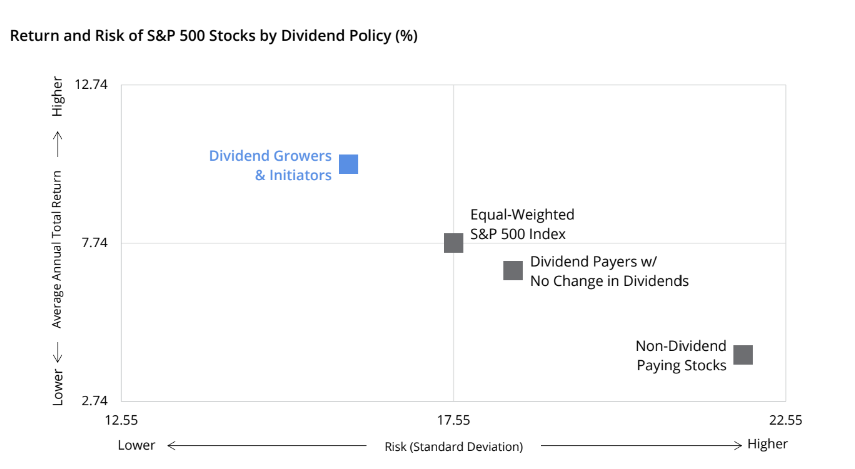
In the world of investing, chasing the highest possible returns often comes at a steep cost: increased volatility and potential losses. That’s where risk-adjusted returns shine. They measure how efficiently an investment generates gains relative to the risk taken, offering a more complete picture than raw performance alone. A powerful chart from Hartford Funds, based on Ned Davis Research data spanning 1973 to 2025, perfectly illustrates the advantages of prioritizing risk-adjusted returns, especially through a focus on dividend growth stocks in the S&P 500.
The scatter plot’s average annual total return (y-axis) against risk, measured as standard deviation (x-axis). It divides S&P 500 stocks into categories based on their dividend behavior over the prior 12 months:
- Dividend Growers & Initiators (stocks that increased dividends or started paying them) sit in the top-left: the highest returns paired with the lowest risk.
- The Equal-Weighted S&P 500 Index anchors the middle as a neutral benchmark.
- Dividend Payers with No Change in Dividends cluster nearby but show less favorable positioning.
- Non-Dividend Paying Stocks land in the bottom-right: the lowest returns with the highest risk.
As the chart’s own analysis states: “Companies that initiate or grow dividends have delivered the highest returns relative to other dividend-paying companies, with less overall risk.” This visual makes one thing crystal clear, superior risk-adjusted returns aren’t about luck: they’re often the result of disciplined dividend strategies.
What Are Risk-Adjusted Returns?
Risk-adjusted returns go beyond simple percentage gains. They factor in volatility (how much prices swing up and down) to show the “reward per unit of risk.” Popular metrics include:
- The Sharpe Ratio, which subtracts the risk-free rate from returns and divides by standard deviation.
- Visual tools like this scatter plot, where the upper-left quadrant represents the sweet spot: strong gains with minimal turbulence.
Why does this matter for long-term investors? High raw returns from volatile assets can erode wealth through big drawdowns, emotional selling, and the drag of compounding on losses. In contrast, strong risk-adjusted returns deliver smoother growth, preserving capital and accelerating wealth building over decades.
Key Benefits of Risk-Adjusted Returns Highlighted by the Dividend Policy Chart
The analysis reveals how dividend growth investing unlocks multiple advantages in the S&P 500. Here’s how focusing on risk-adjusted performance pays off:
- Higher Returns with Lower Volatility
Dividend growers and initiators outperform across the board while keeping risk in check. Unlike non-dividend stocks, which chase growth through price swings alone, dividend-focused companies tend to be mature, cash-flow stable businesses. The result? You capture meaningful total returns (price appreciation plus dividends) without the stomach-churning standard deviation seen in the non-payers group. This efficiency means your portfolio compounds faster over time because losses don’t wipe out prior gains as severely.
- Greater Portfolio Stability and Peace of Mind
High volatility often leads to panic selling during market dips. The chart shows non-dividend stocks suffering the worst risk-return profile, exactly the type of exposure that tests investor resolve. By contrast, risk-adjusted returns from dividend growers provide ballast. Lower standard deviation translates to fewer sleepless nights and a higher likelihood of staying invested through full market cycles. For retirement portfolios or conservative investors, this stability is invaluable.
- Superior Long-Term Compounding
Mathematics favors consistency. Even if two strategies end with similar average returns, the one with lower volatility wins because of reduced “volatility drag.” The S&P 500 benchmark sits squarely in the middle of the chart, solid, but not optimal. Dividend growth stocks push into the high-return, low-risk zone, allowing reinvested dividends to compound on a steadier base. Over the 1973–2025 study period, this approach delivered outsized results relative to peers.
- Built-In Income with Capital Appreciation
Dividend growth isn’t just about yield, it’s about quality. Companies that initiate or raise payouts signal strong fundamentals and management confidence. This dual benefit (regular income plus growth) enhances risk-adjusted returns by providing cash flow even when prices fluctuate. Investors can reinvest dividends during dips, buying more shares at lower prices and amplifying future gains, all while enjoying lower overall portfolio risk than growth-only or non-dividend strategies.
- Better Performance Across Market Environments
The data underscores resilience. Whether in bull markets, recessions, or sideways periods, the dividend growth category consistently occupies the optimal risk-return space. Non-dividend stocks, reliant solely on capital gains, amplify downside moves. By tilting toward risk-adjusted returns, investors reduce drawdown risk and improve the odds of beating the broader market over time.
How to Apply These Insights to Your Investing Strategy
The chart doesn’t just educate, it guides action. It often pays to screen S&P 500 stocks for consistent dividend increases (often called “Dividend Aristocrats” or “Dividend Kings”). Tools like ETF trackers focused on dividend growth (e.g., those mirroring quality payers with rising payouts) offer easy exposure with built-in diversification.
Pair this with broader portfolio construction: allocate a core position to dividend growth for stability, then layer in other assets for balance. Always rebalance periodically and review your personal risk tolerance. Remember, the goal isn’t maximum return, it’s the best risk-adjusted return for your timeline and goals.
Final Takeaway: Risk-Adjusted Returns Are the Smart Path Forward
The chart powered by Ned Davis Research, provides compelling evidence that risk-adjusted returns aren’t a theoretical concept, they’re achievable through proven strategies like dividend growth investing. By favoring companies that initiate or grow dividends, investors secure higher average annual total returns with meaningfully lower risk than the S&P 500 average or non-dividend alternatives.
With constant market uncertainty, prioritizing risk-adjusted returns builds resilient wealth that withstands volatility while delivering reliable growth. Whether you’re a seasoned investor or just starting, this approach, rooted in the data offers a clearer, calmer route to financial success.
About the Author
Joseph M. Favorito, CFP® is a Certified Financial Planner® as well as the founder and managing partner at Landmark Wealth Management, LLC, a fee-only SEC registered investment advisory firm. He specializes in helping individuals and families develop comprehensive financial strategies to achieve their long-term goals.