
Stock buybacks (also called share repurchases) are one of the most common ways public companies return capital to shareholders. When a company buys back its own shares, it reduces the number of shares outstanding. That simple change can increase earnings per share (EPS) and raise the ownership percentage of remaining shareholders, even if the company’s total earnings stay the same.
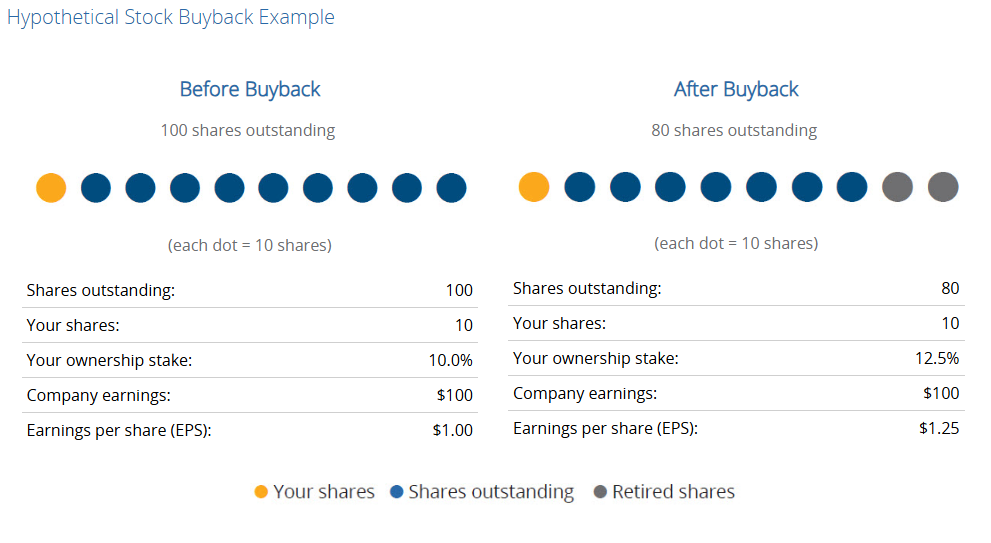
The hypothetical example above illustrates exactly how this works.
Before the Buyback
- 100 shares outstanding
- You own 10 shares = 10% ownership
- Company earns $100
- Earnings per share (EPS) = $1.00
After the Buyback
The company repurchases and retires 20 shares.
- 80 shares outstanding
- You still own 10 shares = 12.5% ownership
- Company still earns $100
- Earnings per share (EPS) = $1.25
Your ownership stake rose from 10% to 12.5%, and EPS increased 25%, without the company earning a single extra dollar. The remaining shares simply claim a larger piece of the same earnings pie.
Why Companies Buy Back Stock
Companies typically repurchase shares for several reasons:
- They believe the stock is undervalued. Management may view the buyback as a good use of excess cash relative to other options.
- To offset dilution from employee stock options or equity grants.
- To return capital efficiently. Buybacks can be more tax-efficient than dividends for many shareholders.
- To boost EPS and key valuation metrics. Higher EPS can make the stock look more attractive on a price-to-earnings basis.
What It Means for Individual Investors
If you already own shares and the company retires a meaningful percentage of its stock, two things happen automatically:
- Your ownership percentage increases.
- Your claim on future earnings (EPS) rises, assuming earnings hold steady or grow.
This is why long-term investors often view consistent, well-timed buybacks favorably, especially when the company is using free cash flow rather than taking on excessive debt.
Important Caveats
Not every buyback creates value. Results depend on:
- The price paid for the shares (buying high destroys value).
- Whether the company is using excess cash or borrowing heavily.
- The long-term trajectory of the business itself.
A buyback that improves EPS in the short term does not guarantee higher stock prices if fundamentals deteriorate.
Bottom Line
Stock buybacks shrink the share count, which can increase both your ownership stake and earnings per share. In the simplified example above, a 20% reduction in shares outstanding lifted ownership from 10% to 12.5% and EPS from $1.00 to $1.25, while total company earnings remained unchanged.
Understanding these mechanics can help investors evaluate whether a company’s repurchase program is truly shareholder-friendly.
About the Author
Joseph M. Favorito, CFP® is a Certified Financial Planner® as well as the founder and managing partner at Landmark Wealth Management, LLC, a fee-only SEC registered investment advisory firm. He specializes in helping individuals and families develop comprehensive financial strategies to achieve their long-term goals.