
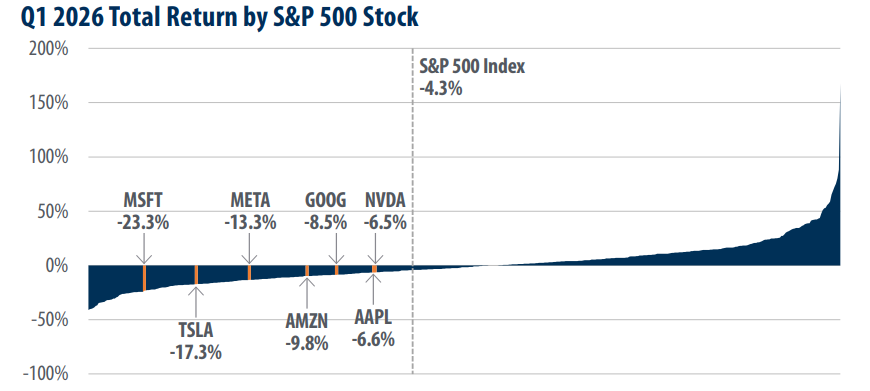
The headline S&P 500 return for the first quarter of 2026 was negative, but many investors with well-diversified portfolios fared better. The above chart citing Bloomberg data highlighting individual stock total returns reveals why. The drop in the index was heavily concentrated in a handful of mega-cap giants, while the average stock, and especially smaller or equal-weighted holdings, performed much stronger.
The S&P 500 finished Q1 2026 down -4.3% on a total return basis. At first glance, that sounds disappointing. But dig deeper into the performance of the 500 individual stocks, and a very different story emerges.
Mega-Cap Stocks Dragged the Index Lower
The chart clearly shows the outsized negative impact from several of the market’s largest names:
- Microsoft (MSFT): -23.3%
- Tesla (TSLA): -17.3%
- Meta Platforms (META): -13.3%
- Alphabet (GOOG): -8.5%
- Amazon (AMZN): -9.8%
- NVIDIA (NVDA): -6.5%
- Apple (AAPL): -6.6%
Because the S&P 500 is market-cap weighted, these big technology and growth stocks carry enormous influence. Until very recently, that outsized influence has been extremely positive in recent years, as cited in this prior analysis.
NVIDIA alone, with a weighting around 7-8% during the quarter, dragged the entire index down by roughly 0.5 percentage points despite a relatively modest -6.5% decline. Microsoft’s steeper drop subtracted even more.
In contrast, the visualization shows an early plunge in the cumulative weighted return, followed by a partial recovery that still left the cap-weighted index in the red.
The Power of Diversification: 290 Stocks Outperformed the Index
Here’s the encouraging part for diversified investors: 290 out of 500 S&P 500 stocks outperformed the index during Q1 2026.
The standout winner was SanDisk Corporation (SNDK), which surged an impressive 167.7% in the quarter, fueled by strong demand in AI-related memory and data storage. Yet because SanDisk had only a tiny weighting of about 0.14% in the index, its massive gain contributed just 0.09 percentage points to the overall S&P 500 return, a fraction of the negative drag from the mega-caps.
This concentration effect explains why the equal-weighted S&P 500 (where every stock gets roughly the same 0.2% weighting) actually posted a positive return of +0.7% for the quarter. That’s a stark contrast to the traditional market-cap weighted index’s -4.3% decline.
Small-cap stocks, as measured by the Russell 2000, also gained nearly +1%, further highlighting the broadening of market leadership beneath the surface.
What This Means for Investors in 2026
This Q1 dynamic is a classic reminder of the differences between:
- Market-cap weighted indexing (like the standard S&P 500) — which rewards past winners but can amplify losses when those winners stumble.
- Equal-weighted or broader diversification strategies which reduce reliance on a few mega-caps and better capture the performance of the “average” stock.
As an investor, if you followed traditional advice and built a diversified portfolio across sectors, market caps, and styles, your results in Q1 2026 were likely better than the headline -4.3% of the S&P 500.
Market breadth improved notably during the quarter, with value stocks outperforming growth in several periods and more stocks participating on the upside. This type of rotation often signals healthier underlying market conditions, even when the cap-weighted benchmark lags.
Key Takeaway for Your Portfolio
Don’t judge your entire portfolio solely by the S&P 500 headline number. In quarters like Q1 2026, where a small number of heavily weighted stocks dominate the downside, true diversification will often deliver smoother and sometimes superior results.
Looking ahead, investors should consider whether their allocations properly balance exposure to mega-cap tech leaders with broader participation across the market. Value strategies, small-cap tilts, or sector-balanced approaches could help mitigate the impact of future concentration-driven volatility.
The S&P 500 remains one of the best long-term benchmarks for U.S. large-cap stocks, but Q1 2026 serves as a timely illustration: sometimes the index tells only part of the story. And the need for greater diversification remains an important part of portfolio construction.
About the Author
Joseph M. Favorito, CFP® is a Certified Financial Planner® as well as the founder and managing partner at Landmark Wealth Management, LLC, a fee-only SEC registered investment advisory firm. He specializes in helping individuals and families develop comprehensive financial strategies to achieve their long-term goals.