
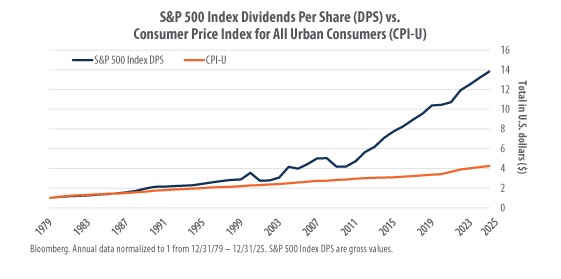
For decades, investors have turned to the S&P 500 for growth, but one often-overlooked factor continues to deliver remarkable results: dividends. New data comparing S&P 500 dividends per share (DPS) to the Consumer Price Index for All Urban Consumers (CPI-U) reveals a striking trend. Dividend growth has dramatically outpaced inflation over the past 45+ years.
Dividends vs. Inflation: What the Data Shows
The chart above illustrates S&P 500 Index Dividends Per Share (gross) versus CPI-U, normalized to a base of 1.00 as of December 31, 1979, through the end of 2025.
- The blue line (S&P 500 DPS) shows strong, consistent upward momentum, climbing sharply higher in recent decades.
- The orange line (CPI-U) represents inflation and rises far more modestly.
By the end of the period, S&P 500 dividends per share had grown to approximately 14 times their 1979 level, while inflation had increased to roughly 4 times. This means dividends alone have significantly outpaced the rising cost of living, preserving and enhancing purchasing power for income-focused investors.
Why Dividend Growth Matters More Than Ever
Inflation quietly erodes the real value of fixed-income investments like bonds and cash. However, high-quality companies in the S&P 500 have demonstrated an ability to raise dividends over time, often at rates well above inflation. This dividend growth is driven by:
- Corporate earnings expansion – Profitable companies generate more cash flow to return to shareholders.
- Dividend aristocrats and kings – Many S&P 500 constituents have increased payouts for 25, 50, or even 60+ consecutive years.
- Compounding effect – Reinvested dividends purchase more shares over time, accelerating total returns.
Historically, dividends have accounted for a substantial portion of the S&P 500’s total return. In periods of high inflation or market volatility, reliable dividend payers often provide stability that pure growth stocks lack.
The Inflation Hedge Investors Need
With inflation remaining a persistent concern for retirees, savers, and long-term investors, the ability of S&P 500 dividends to outpace CPI-U is particularly compelling.
Consider this: an investor relying solely on dividend income from a broad S&P 500 exposure in 1979 would have seen their income stream grow far faster than their grocery bills, housing costs, or healthcare expenses. This real income growth helps maintain lifestyle in retirement without needing to dip into principal as aggressively.
How to Position Your Portfolio for Dividend Strength
- Focus on quality – Prioritize companies with strong balance sheets, consistent earnings growth, and proven dividend increase track records.
- Diversify across sectors – While technology has driven recent market gains, traditional dividend sectors like consumer staples, healthcare, and industrials often shine during inflationary periods.
- Consider dividend ETFs or index funds – Low-cost vehicles tracking the S&P 500 or high-dividend strategies offer broad exposure with automatic reinvestment.
- Reinvest for compounding – Using a dividend reinvestment plan (DRIP) maximizes the power of time and compounding.
The long-term chart of S&P 500 dividends versus CPI-U sends a clear message: dividends are not just a nice bonus; they’re a proven inflation-beating engine. While stock prices can be volatile, the steady rise in corporate payouts has delivered real wealth creation for patient investors.
As you build or review your investment strategy, remember that total return includes both price appreciation and dividends. The compounding power of growing dividends may be one of the most reliable tools available to protect and grow your purchasing power over time.
About the Author
Joseph M. Favorito, CFP® is a Certified Financial Planner® as well as the founder and managing partner at Landmark Wealth Management, LLC, a fee-only SEC registered investment advisory firm. He specializes in helping individuals and families develop comprehensive financial strategies to achieve their long-term goals.