
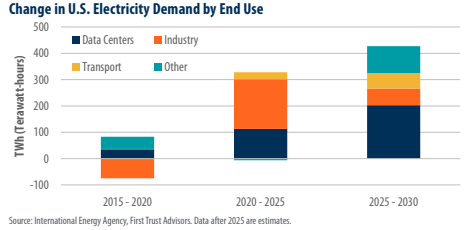
The energy sector is undergoing a seismic shift, and the chart from the International Energy Agency and First Trust highlight exactly why forward-looking investors should pay close attention. The chart above reveals the projected explosive growth in U.S. electricity demand by end use through 2030. This paints a clear picture: data centers and AI are driving unprecedented power needs, and high-reliability sources will be needed to meet the demand.
Explosive U.S. Electricity Demand Growth Driven by Data Centers
The chart above shows the change in U.S. electricity demand by end use in terawatt-hours (TWh), broken into periods: 2015–2020, 2020–2025, and the 2025–2030 forecast.
Demand growth is accelerating dramatically. The 2025–2030 bar towers over earlier periods, with data centers (dark blue) accounting for the largest share of the increase, roughly doubling their contribution compared to the prior five years. Industry (orange) and transport (yellow, largely EVs) add meaningful volume, while “other” (teal) rounds out the surge.
This isn’t abstract forecasting. AI training and cloud computing require always-on, 24/7 power. A single large data center campus can consume as much electricity as a mid-sized city. With hyperscalers like Microsoft, Google, and Amazon racing to expand, the U.S. is facing a structural power deficit that intermittent renewables alone cannot close quickly.
Reliability is an issue, as illustrated in the chart below.
What the Capacity Factor Chart Reveals About Energy Reliability
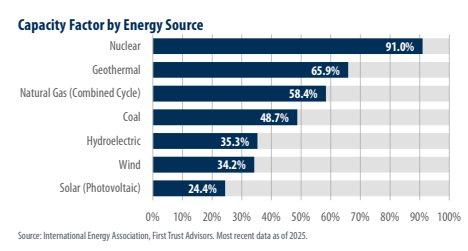
Capacity factor measures how consistently a power plant generates electricity relative to its maximum potential. The data as of 2025 is eye-opening:
- Nuclear: 91.0% – the undisputed leader
- Geothermal: 65.9%
- Natural Gas (Combined Cycle): 58.4%
- Coal: 48.7%
- Hydroelectric: 35.3%
- Wind: 34.2%
- Solar (Photovoltaic): 24.4%
Nuclear’s near-constant operation means one gigawatt of installed nuclear capacity delivers far more actual electricity than the same amount of wind or solar. Renewables, while growing, require massive overbuilding and expensive storage to compensate for their intermittency. This reality has direct investment implications: projects with high-capacity factors deliver better returns per dollar invested in infrastructure.
Why These Charts Signal Strong Energy Investment Opportunities
The combination of high nuclear capacity factor and surging data-center demand creates a powerful investment thesis for 2026 and beyond:
- Nuclear Renaissance Is Already Underway Nuclear’s 91% capacity factor makes it the perfect baseload partner for data centers that cannot tolerate blackouts or curtailments. Utilities with existing nuclear fleets or plans to restart/reactivate plants are positioned for outsized gains. Expect strong capital flows into nuclear operators, uranium miners, and SMR (small modular reactor) developers.
- Natural Gas as the Flexible Bridge Fuel At 58.4% capacity factor, combined-cycle gas plants offer quick ramp-up capability to complement renewables and nuclear. With LNG exports and domestic demand both rising, midstream and power-generation companies in this space remain attractive.
- Renewables Face Headwinds Without Storage Solutions Solar and wind’s low-capacity factors (24.4% and 34.2%) mean developers must secure long-term power purchase agreements (PPAs) at premium prices or pair projects with battery storage. Investors in pure-play solar/wind without storage exposure may see compressed margins as grid operators prioritize reliability.
- Data Center and Utility Synergies REITs specializing in data center infrastructure and regulated utilities that can co-locate generation with new hyperscale campuses stand to benefit from both sides of the demand equation.
Risks to Monitor
Policy shifts, permitting delays, and interest-rate sensitivity can affect capital-intensive energy projects. Supply-chain issues for nuclear components and competition for skilled labor also warrant attention. However, the structural tailwinds from AI-driven demand appear durable through at least 2030.
Bottom line: The 2025 capacity factor data and U.S. electricity demand forecasts underscore a simple truth, reliable, high-capacity-factor power is the scarcest and most valuable commodity in the AI era. Investors who position portfolios around nuclear, natural gas, and the infrastructure enabling this transition may capture significant long-term value as the U.S. electrifies and digitizes at an unprecedented pace. At Landmark, we have maintained a dedicated position to energy infrastructure in client portfolios for several years in anticipation of this rapid expansion.
About the Author
Joseph M. Favorito, CFP® is a Certified Financial Planner® as well as the founder and managing partner at Landmark Wealth Management, LLC, a fee-only SEC registered investment advisory firm. He specializes in helping individuals and families develop comprehensive financial strategies to achieve their long-term goals.