
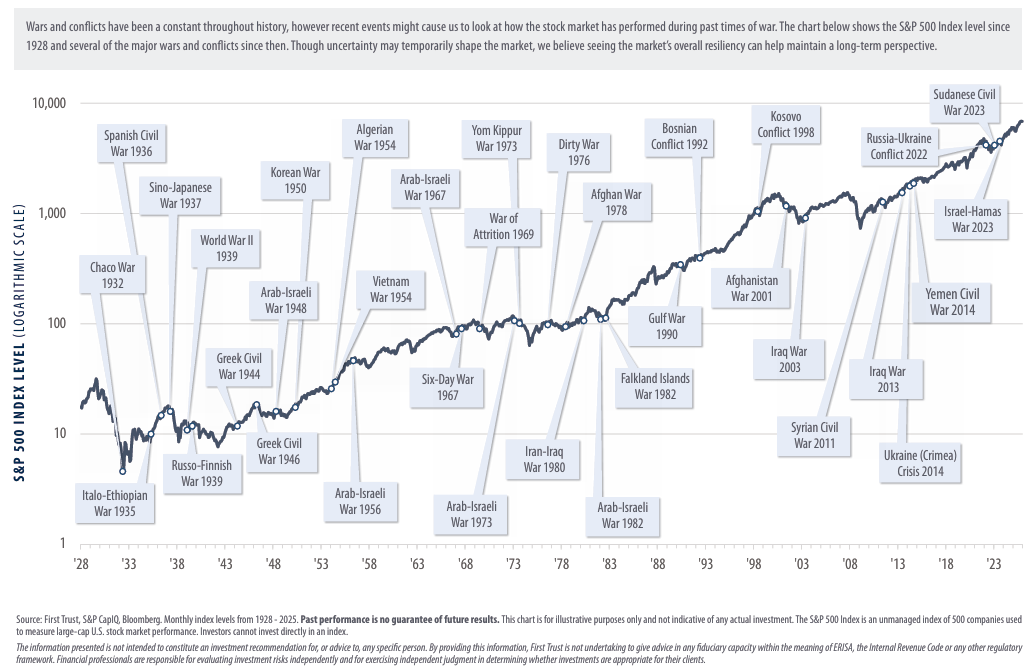
The S&P 500 has demonstrated remarkable long-term resilience through nearly a century of global conflicts, as illustrated in the referenced chart courtesy of First Trust (sourced from S&P CapIQ and Bloomberg data).
The chart plots the S&P 500 Index, which shows compound growth over time while highlighting major wars and geopolitical events. Despite periodic dips tied to uncertainty, the index has exhibited a clear overall upward trajectory from levels in the single digits in the late 1920s to well over 6,000 in recent periods.
Key historical conflicts annotated on the chart include:
- Early 1930s: Chaco War (1932), Italo-Ethiopian War (1935), Spanish Civil War (1936), Sino-Japanese War (1937), Russo-Finnish War (1939), and World War II (1939).
- 1940s: Greek Civil War (1944/1946), Arab-Israeli War (1948).
- 1950s: Korean War (1950), Algerian War (1954), Arab-Israeli conflicts (1956), Vietnam War onset (1954).
- 1960s–1970s: Six-Day War (1967), War of Attrition (1969), Yom Kippur War (1973), Dirty War (1976), Iran-Iraq War (1980).
- 1980s–1990s: Falklands War (1982), Gulf War (1990), Bosnian Conflict (1992), Kosovo Conflict (1998).
- 2000s–2010s: Afghanistan War (2001), Iraq War (2003), Syrian Civil War (2011), Ukraine (Crimea) Crisis (2014), Yemen Civil War (2014).
- Recent years: Russia-Ukraine Conflict (2022), Israel-Hamas War (2023), Sudanese Civil War (2023).
The chart’s message is clear: while geopolitical shocks and wars introduce short-term volatility and uncertainty, often causing temporary market dips, the U.S. stock market has historically recovered and continued its long-term growth. The upward slope in the chart persists across these events, underscoring the market’s resiliency.
In times of elevated geopolitical tension, such as recent conflicts in Ukraine, the Middle East, and now the conflict with Iran, this visual reminder demonstrates why investors should maintain a long-term perspective. Markets have weathered far greater uncertainties before, often emerging stronger over extended periods. Staying invested through volatility has historically rewarded those with patience, as the index’s trajectory shows consistent compounding growth despite the labels of wars and crises illustrated in the timeline.
This perspective should be a valuable reminder for anyone navigating current events and their potential market implications. Always remember, short-term noise from global headlines rarely derails the broader upward trend driven by economic innovation, corporate earnings, and productivity over decades.
None of this is meant to diminish the inherent horrors of war, that most of us have never witnessed, and hopefully never will. However, when examining the financial risk from the perspective of an investor, and what disruptions this may cause, the historical precedent is clear. Long-term investment discipline has been rewarded.
About the Author
Joseph M. Favorito, CFP® is a Certified Financial Planner® as well as the founder and managing partner at Landmark Wealth Management, LLC, a fee-only SEC registered investment advisory firm. He specializes in helping individuals and families develop comprehensive financial strategies to achieve their long-term goals.