
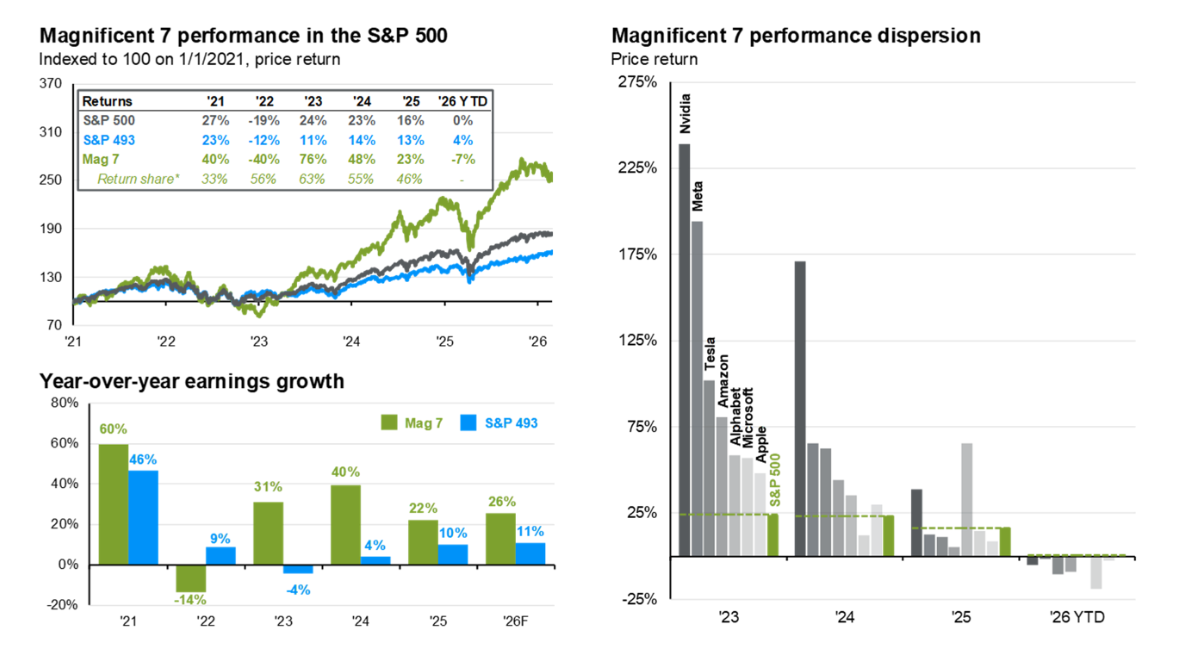
Much has been made in recent years about the Magnificent 7, also known as Apple, Amazon, Alphabet (Google), Meta, Microsoft, Nvidia, and Tesla, and the dominant force they have been behind S&P 500 performance for the past five years. New data from FactSet, Standard & Poor’s, and J.P. Morgan Asset Management illustrate just how outsized their impact remains, even as broader market participation evolves in 2026.
Since January 1, 2021, the Magnificent 7 have dramatically outperformed the rest of the index. The chart above tracks price returns indexed to 100 through February 2026:
- 2021: Mag 7 returned +40% versus +27% for the S&P 500 and +23% for the S&P 493 (S&P 500 ex-Mag 7).
- 2022 bear market: Mag 7 fell -40%, yet still accounted for a 56% share of index-level returns due to their heavy weighting.
- 2023: Mag 7 surged +76% (versus +24% for the S&P 500), contributing 63% of total market gains.
- 2024: Mag 7 delivered +48% (versus +23% S&P 500), with a 55% return share.
- 2025: Mag 7 posted +23% (versus +16% S&P 500), contributing 46%.
- 2026 thru February (as of the latest data point): Mag 7 is down -7% while the S&P 500 is flat at 0% and the S&P 493 is up +4%.
This recent reversal in Mag 7 performance marks the first period since 2022 where the group has lagged the broader market, highlighting increased dispersion within the “Magnificent 7” cohort.
Stronger Earnings Growth Underpins Mag 7 Outperformance
The year-over-year earnings growth comparison reveals why the Mag 7 have sustained leadership:
- 2021: Mag 7 +60% vs. S&P 493 +46%
- 2022: Mag 7 -14% vs. S&P 493 +9%
- 2023: Mag 7 +31% vs. S&P 493 -4%
- 2024: Mag 7 +40% vs. S&P 493 +4%
- 2025: Mag 7 +22% vs. S&P 493 +10%
- 2026 (forecast): Mag 7 +26% vs. S&P 493 +11%
Even during the 2022 downturn, the Mag 7’s earnings resilience, fueled by AI, cloud computing, and digital advertising, set the stage for explosive rebounds in 2023–2024. Forward estimates for 2026 continue to show the group growing earnings more than twice as fast as the rest of the S&P 500.
Magnificent 7 Performance Dispersion: Winners and Laggards Emerge
The right-hand panel of the chart highlights Magnificent 7 performance dispersion across individual stocks. Nvidia has been the standout, delivering triple-digit returns in multiple periods and anchoring group gains. Meta, Tesla, and Amazon have also posted outsized results in select years, while Apple and Microsoft have delivered more stable but still market-beating performance.
This dispersion underscores a key investment theme: Mag 7 impact on the S&P 500 is no longer uniform. While the group as a whole continues to drive index-level returns, concentration risk has intensified, particularly around AI leaders like Nvidia. Investors seeking exposure to “Magnificent 7 stocks” must now differentiate between high-growth AI plays and more mature mega-caps.
What This Means for Investors in 2026 and Beyond
The latest FactSet, Standard & Poor’s, and J.P. Morgan Asset Management data confirm that the Magnificent 7 remain the primary engine of S&P 500 performance. Their superior earnings growth has led to premium valuations and heavy index weighting. However, the 2026 YTD pullback and rising dispersion signal that the era of effortless group outperformance may be moderating.
Key takeaway for investors:
- Diversification within the S&P 500 matters more than ever.
- Broader S&P 493 participation is improving, reducing single-stock concentration risk.
- Earnings momentum remains the fundamental driver.
The Magnificent 7 performance story is far from over, but the above chart makes one thing clear: their outsized influence on S&P 500 returns now comes with significant concentration risk, which needs to be considered in reference to the possible impact on an individual’s financial plan, and the need for diversity.
About the Author
Joseph M. Favorito, CFP® is a Certified Financial Planner® as well as the founder and managing partner at Landmark Wealth Management, LLC, a fee-only SEC registered investment advisory firm. He specializes in helping individuals and families develop comprehensive financial strategies to achieve their long-term goals.