
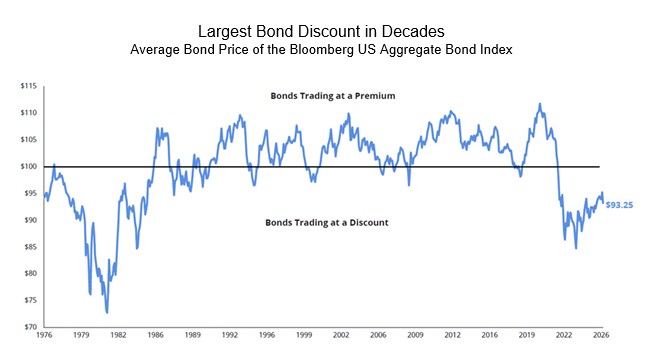
As of recent data, the average price of bonds in the Bloomberg US Aggregate Bond Index has fallen to around $93.25, representing one of the deepest discounts in decades.
This chart of the index’s average bond price from 1976 to the present highlights a striking shift: after years of trading at or above par ($100) in a low-rate environment, bonds have moved firmly into discount territory following the post-pandemic rate hikes.
Understanding the Bloomberg US Aggregate Bond Index
The Bloomberg US Aggregate Bond Index (often called the “Agg”) serves as the primary benchmark for the US investment-grade bond market. It tracks a broad mix of securities, including US Treasuries, government-related issues, corporate bonds, mortgage-backed securities, and asset-backed securities.
- Price above $100: Bonds trading at a premium (common in low-interest-rate periods).
- Price at $100: Trading at par.
- Price below $100: Trading at a discount (as seen now).
The current level near $93 marks a notable deviation from the premium territory that dominated much of the 1990s through the early 2020s.
Why Are Bonds Trading at Such a Deep Discount?
Bond prices and yields have an inverse relationship. When interest rates rise, prices of existing bonds with lower coupon rates fall to make their yields competitive with new issues.
Key drivers of the recent discount include:
- Aggressive Federal Reserve rate hikes in response to post-pandemic inflation, pushing yields higher and hammering bond prices (notably the record -13% drawdown in 2022).
- Higher prevailing yields: The index’s yield-to-worst has hovered in the 4-5% range in recent years, far above the sub-2% levels of the late 2010s.
- Supply and fiscal dynamics: Elevated government borrowing, quantitative tightening, and deficit concerns have influenced longer-term yields.
Despite a solid recovery in 2025 driven by rate cuts, the average price remains below par, reflecting lingering effects of the higher-rate regime.
Implications for Investors
A deep discount creates both opportunities and considerations:
Potential Upside:
- Capital appreciation: If rates stabilize or decline further, bond prices could rise toward par, delivering gains in addition to interest income.
- Higher yields: Discount bonds effectively offer attractive income as prices accrete to par at maturity (for those held to term).
- Diversification and ballast: In a portfolio context, the Agg provides broad exposure and can act as a stabilizer during stock market volatility.
Risks to Watch:
- Interest rate risk: Further rate increases or persistent inflation could pressure prices more.
- Duration and maturity: The index has an effective duration around 5-6 years, making it moderately sensitive to rate changes.
- Credit and spread dynamics: While investment-grade focused, corporate and MBS components warrant monitoring amid economic uncertainty.
Outlook for Bonds in 2026 and Beyond
With the index still in discount territory, many analysts see value for long-term investors seeking income and potential total return. However, returns may moderate compared to 2025’s strong performance as the Fed’s easing cycle potentially slows.
Factors to monitor include inflation trends, fiscal policy impacts on supply, and central bank actions. For income-focused investors, the current setup, higher yields combined with discounted prices could represent an attractive entry point relative to the ultra-low-rate era.
ETFs like the iShares Core U.S. Aggregate Bond ETF (AGG) offer easy, low-cost access to this benchmark, with recent share prices reflecting the index’s movements. However, unlike investing in the stock market, due to the size, complexity and inefficiency in the pricing of the fixed income markets, active management in bonds has consistently demonstrated solid benefits. In today’s markets, this can also be achieved via lower cost ETF’s, mutual funds or the management of individual bond purchases.
Bottom Line: The largest bond discount in decades underscores a transformed fixed-income landscape. Whether you’re reallocating a portfolio, seeking yield, or hedging against volatility, understanding the Bloomberg US Aggregate Bond Index’s price action is essential. It’s always important to consult with your financial advisor to align these opportunities with your specific risk tolerance and goals.
About the Author
Joseph M. Favorito, CFP® is a Certified Financial Planner® as well as the founder and managing partner at Landmark Wealth Management, LLC, a fee-only SEC registered investment advisory firm. He specializes in helping individuals and families develop comprehensive financial strategies to achieve their long-term goals.