
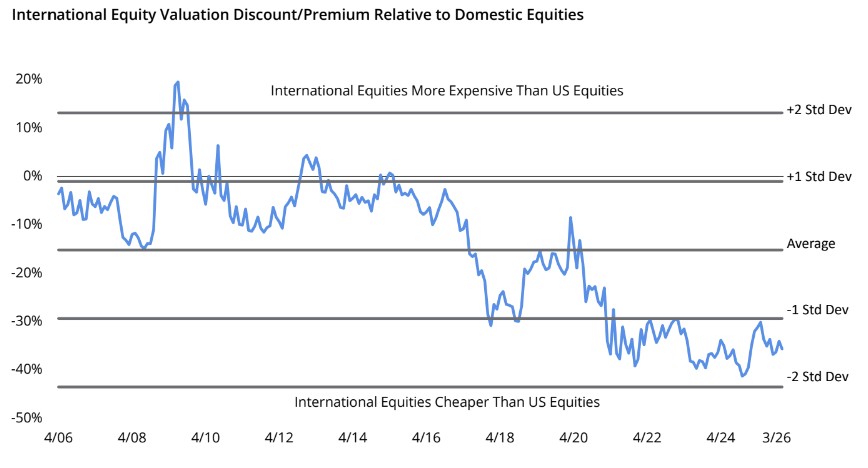
Investors evaluating portfolio diversification are facing a striking picture in 2026: international equities are trading at one of the widest valuation discounts relative to U.S. stocks in decades. A recent chart provided by Hartford funds tracking the international equity valuation discount/premium (S&P 500 vs MSCI World ex US Index) highlights this persistent gap, raising important questions about global investment opportunities and potential mean reversion.
What the Chart Shows: International Stocks Deeply Undervalued
The chart plots the relative valuation from April 2006 through March 2026. Key observations include:
- Long-term average: International equities have historically traded at a modest discount to U.S. stocks (hovering near the zero line).
- Recent trend: Since around 2018, the discount has widened dramatically. The line has spent extended periods below the -1 and even -2 standard deviation bands.
- Current positioning (as of early 2026): International equities remain deeply discounted, sitting near or below the -2 standard deviation level, a zone historically associated with extreme cheapness relative to U.S. equities.
- Historical extremes: Brief periods of premium valuation occurred around 2009–2010 (post-financial crisis), but the post-2018 era has been dominated by international under-valuation.
This visual clearly illustrates the phrase investors often hear: “International equities are cheaper than U.S. equities.”
Why Are International Stocks So Cheap?
Several structural and cyclical factors have contributed to this valuation divergence:
- U.S. Market Dominance – The U.S. equity market, led by mega-cap technology and growth stocks, has outperformed global peers for much of the past decade, pushing valuations higher.
- Economic and Geopolitical Uncertainty – Trade tensions, slower growth in Europe and emerging markets, and currency fluctuations have weighed on international valuations.
- Earnings and Growth Differentials – Stronger U.S. corporate earnings growth, particularly in tech and AI-related sectors, has justified higher multiples domestically.
- Interest Rate and Policy Divergence – Varying monetary policies across central banks have impacted relative attractiveness.
Despite these headwinds, many analysts argue that the current discount has reached levels that may offer a compelling entry point for long-term investors seeking diversification.
Historical Perspective: Has This Discount Preceded Strong Returns?
Valuation gaps of this magnitude have often preceded periods of stronger relative performance for international stocks:
- When international equities traded at significant discounts in the past, subsequent 5–10 year returns have frequently outpaced U.S. equities as valuations normalized.
- The current reading near -2 standard deviations is statistically rare and has historically signaled attractive forward returns for non-U.S. markets.
However, timing a mean reversion is notoriously difficult. The “lost decade” for international stocks has tested investor patience, but the valuation signal remains one of the strongest arguments for global allocation today.
Investment Implications for 2026 and Beyond
For investors and financial advisors constructing portfolios, this chart underscores several strategic considerations:
- Diversification Benefits: A home-country bias toward U.S. stocks may leave portfolios exposed if the valuation gap narrows through international outperformance.
- Value Opportunities: Sectors and regions outside the U.S. (Europe, Japan, emerging markets) often offer higher dividend yields and lower price-to-earnings ratios.
- Risk Management: While cheap valuations reduce downside risk, they do not eliminate it. Currency risk, political developments, and slower growth potential remain relevant.
- Portfolio Rebalancing: Many institutional investors are increasing exposure to international equities or using vehicles like international ETFs and mutual funds to capitalize on the discount.
Final Thoughts: A Historic Buying Opportunity or Value Trap?
The persistent international equity valuation discount relative to domestic (U.S.) equities is one of the most notable features of the current global market environment. As of March 2026, the discount appears extreme by historical standards, suggesting international stocks are significantly cheaper than their U.S. counterparts.
Whether this leads to meaningful outperformance will depend on a global economic recovery, corporate earnings trends, and geopolitical stability. For patient, long-term investors, the data in this chart provides a compelling case for considering greater international exposure as part of a diversified equity strategy.
About the Author
Joseph M. Favorito, CFP® is a Certified Financial Planner® as well as the founder and managing partner at Landmark Wealth Management, LLC, a fee-only SEC registered investment advisory firm. He specializes in helping individuals and families develop comprehensive financial strategies to achieve their long-term goals.