
What is a hyperscaler? A hyperscaler is a massive cloud computing and data center operator, such as Amazon Web Services (AWS), Microsoft Azure, Google Cloud, and similar giants that build and manage infrastructure at an unprecedented global scale to support cloud services, artificial intelligence (AI), and digital workloads.
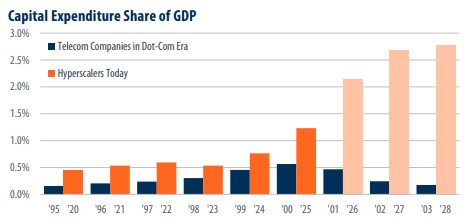
Capital expenditure (capex) trends among today’s hyperscalers are signaling one of the largest infrastructure buildouts in history, significantly outpacing the investment intensity of telecom companies during the late-1990s dot-com era. A comparative chart tracking capex as a percentage of GDP highlights this shift, underscoring the enormous investments being made in AI data centers, cloud infrastructure, and next-generation digital technologies.
Telecom Dot-Com Era vs. Hyperscalers Today: Key Data Comparison
The bar chart provided courtesy of FT Trust & Bloomberg contrasts two pivotal investment cycles:
- Blue bars represent telecom companies in the dot-com era (roughly 1995–2003).
- Orange bars illustrate hyperscalers from 2020 through projected figures to 2028.
During the dot-com period, telecom capex as a share of GDP stayed relatively contained, typically ranging between 0.2% and 0.6%, with a peak around 2000–2001 as companies rapidly expanded fiber-optic networks and broadband capacity.
Hyperscalers today, however, are operating at a much higher level of capital intensity. Beginning near 0.5% in the early 2020s, their capex share of GDP has climbed sharply, exceeding 2.5% in recent years and remaining elevated through 2028 projections. This reflects aggressive spending on hyperscale data centers, semiconductors, power generation, and networking equipment to fuel surging demand for AI training, cloud computing, and enterprise digital transformation.
Economic Significance and Investment Implications
This divergence carries important implications:
- AI Infrastructure Supercycle: Backed by robust revenue from cloud and AI services, hyperscaler investments appear more fundamentally supported than the speculative telecom boom of the late 1990s.
- Broad Economic Impact: Elevated spending is driving growth across the semiconductor, energy, construction, and equipment supply chains, acting as a powerful economic multiplier.
- Challenges Ahead: Rapid expansion also highlights constraints around power availability, supply chains, and sustainability, prompting hyperscalers to pursue innovative energy solutions including nuclear and renewables.
- Investor Considerations: The chart suggests sustained opportunities in data center REITs, chip manufacturers, power utilities, and related infrastructure plays, provided companies continue delivering strong returns on invested capital.
Lessons from History
While the dot-com telecom investments ultimately led to overcapacity and a market correction, today’s hyperscaler capex is tied to measurable demand drivers in AI and cloud. Still, disciplined execution remains critical to avoid similar pitfalls.
The data clearly shows hyperscalers committing capital at a scale that dwarfs the earlier era when viewed relative to GDP, reflecting the central role of digital infrastructure in the modern economy.
Looking Ahead to 2028
Projections indicate hyperscaler capital intensity will likely stay high through at least 2028. This ongoing wave is expected to continue benefiting suppliers and supporting technological advancement across industries.
Hyperscalers are powerhouse operators of global cloud and AI infrastructure and are driving capital expenditure levels far beyond those seen in the dot-com telecom era. As AI adoption accelerates, this sustained investment cycle could define economic and technological progress throughout the decade.
However, investor enthusiasm for AI-related stocks is partly fueled by expectations of continued hyperscaler spending. If spending outpaces demand, growth narratives could weaken, triggering multiple compression across semiconductors, data center REITs, networking equipment, and cloud providers. A sharp re-rating of valuations is possible, especially for companies with heavy exposure to AI capex.
While major hyperscalers have strong balance sheets today, prolonged high capex with sub-par returns could increase leverage and raise borrowing costs, which could lead to a similar environment to the dot.com bust of 2000. As with previous computing cycles, costs per unit of compute and energy efficiency improvements could make current investments more viable over time.
About the Author
Joseph M. Favorito, CFP® is a Certified Financial Planner® as well as the founder and managing partner at Landmark Wealth Management, LLC, a fee-only SEC registered investment advisory firm. He specializes in helping individuals and families develop comprehensive financial strategies to achieve their long-term goals.