
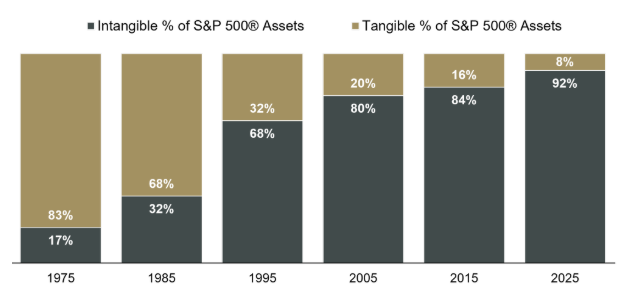
In recent decades, the composition of corporate balance sheets across America’s largest companies has undergone a dramatic transformation. A new analysis of S&P 500 assets reveals a clear long-term trend: intangible assets have surged from a modest 17% in 1975 to a dominant 92% in 2025, while tangible assets have declined from 83% to just 8%.
This evolution reflects the rise of the knowledge economy, driven by software, intellectual property, brands, and data, all hallmarks of the technology boom.
The Data: A 50-Year Evolution
The following breakdown, based on Kenneth French data library at Dartmouth (as of 2/28/2026), which originates from the Ocean Tomo Intangible Asset Market Value (IAMV) Study, illustrates the steady rise of intangibles:
- 1975: Intangible assets = 17% | Tangible assets = 83%
- 1985: Intangible assets = 32% | Tangible assets = 68%
- 1995: Intangible assets = 68% | Tangible assets = 32%
- 2005: Intangible assets = 80% | Tangible assets = 20%
- 2015: Intangible assets = 84% | Tangible assets = 16%
- 2025: Intangible assets = 92% | Tangible assets = 8%
What began as a gradual shift accelerated sharply in the 1980s and 1990s, coinciding with the personal computer revolution, the internet boom, and the explosive growth of software and biotech companies. By the mid-2000s, intangibles had become the clear majority.
It’s important to clarify that the “92% intangible asset” figure does not mean that 92% of the U.S. economy or corporate assets physically exist only in digital form. Rather, it refers to the percentage of the S&P 500’s total market capitalization that is not directly explained by traditional tangible assets such as factories, equipment, inventory, and real estate. In today’s economy, investors increasingly assign value to intangible assets including intellectual property, software, data, patents, brand equity, customer networks, and proprietary technology. This shift highlights how modern market valuation has evolved from an industrial-based economy toward a knowledge-driven economy where innovation, scalability, and digital ecosystems play a much larger role in determining corporate value.
Why Intangible Assets Now Dominate S&P 500 Companies
Traditional balance sheets once emphasized physical assets, such as factories, machinery, real estate, and inventory. Today, the most valuable companies derive their worth from assets that don’t physically exist in the same way:
- Intellectual Property & Patents – Especially in tech, pharmaceuticals, and semiconductors.
- Software and Digital Platforms – Cloud computing, apps, algorithms, and data infrastructure.
- Brand Value & Customer Relationships – Think Apple, Microsoft, Google, and Coca-Cola.
- R&D and Human Capital – Investments in innovation that accounting rules increasingly recognize.
Accounting standards such as the Financial Accounting Standards Board (FASB) updates have evolved to better capture these non-physical assets, but many still argue that traditional financial statements understate their true economic value.
Investment Implications in the Intangible Economy
This profound shift carries important lessons for investors:
- Valuation Metrics Must Adapt – Price-to-book ratios and traditional asset-based valuations can be misleading when most value sits off the balance sheet as intangibles.
- Tech and Growth Stocks Lead – Companies with strong moats in software, data, and brands have captured disproportionate market gains.
- Risk and Durability – Intangible assets can be more scalable but also more vulnerable to disruption, regulatory changes, or loss of key talent.
- Portfolio Positioning – Diversified exposure to firms that successfully monetize intellectual capital has become central to long-term performance.
The Bottom Line
The data is unequivocal: S&P 500 balance sheets have flipped. The technology boom didn’t just change how companies operate, it fundamentally altered what makes them valuable. As we move deeper into the 2020s, understanding the intangible economy is no longer optional for investors and financial professionals.
Companies that invest wisely in research, innovation, branding, and digital infrastructure are best positioned to thrive, while those reliant on aging physical assets may continue to lag in relative importance and performance.
However, maintaining exposure to tangible assets remains essential for a well-rounded investment portfolio. At the same time, as AI adoption accelerates, the value of many traditional physical assets may be further enhanced through technology-driven productivity gains, operational efficiencies, and improved resource management.
About the Author
Joseph M. Favorito, CFP® is a Certified Financial Planner® as well as the founder and managing partner at Landmark Wealth Management, LLC, a fee-only SEC registered investment advisory firm. He specializes in helping individuals and families develop comprehensive financial strategies to achieve their long-term goals.