
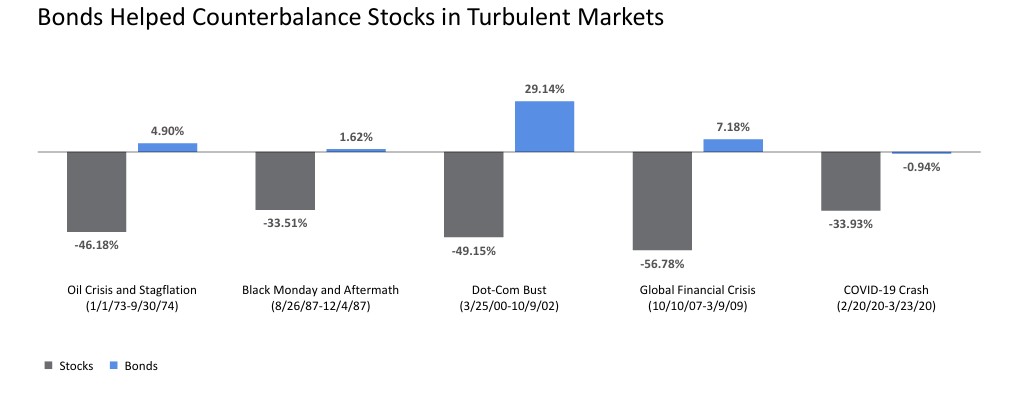
In periods of severe market stress, stocks and bonds have often moved in opposite directions, or at least at very different magnitudes, providing a valuable cushion for diversified portfolios. Historical data spanning five major crises illustrates this dynamic clearly: while equities suffered deep losses, fixed-income assets frequently delivered positive or far milder returns.
Key Historical Episodes
Here is a summary of stock and bond performance during five well-known turbulent periods:
| Crisis Period | Stocks | Bonds |
| Oil Crisis and Stagflation (1/1/73 – 9/30/74) | –46.18% | +4.90% |
| Black Monday and Aftermath (8/26/87 – 12/4/87) | –33.51% | +1.62% |
| Dot-Com Bust (3/25/00 – 10/9/02) | –49.15% | +29.14% |
| Global Financial Crisis (10/10/07 – 3/9/09) | –56.78% | +7.18% |
| COVID-19 Crash (2/20/20 – 3/23/20) | –33.93% | –0.94% |
These figures highlight a consistent pattern: bonds acted as a counterbalance in four of the five episodes and limited the damage even in the fifth.
Why Bonds Often Offset Stock Declines
During equity sell-offs driven by economic shocks, rising uncertainty, or liquidity squeezes, investors frequently rotate toward higher-quality fixed-income assets. This “flight to quality” tends to support bond prices (and therefore total returns) even as stock prices fall.
- In the 1970s oil crisis and stagflation, stocks collapsed under the weight of soaring energy prices and inflation, while bonds still managed a modest gain.
- The sharp, short 1987 Black Monday crash produced a roughly one-third equity decline; bonds eked out a small positive return.
- The multi-year dot-com bust saw the steepest relative outperformance by bonds (+29%), as the technology-driven equity bubble deflated while interest rates declined.
- The Global Financial Crisis delivered the largest stock drawdown in the sample (nearly –57%), yet intermediate and longer-term bonds posted solid positive returns amid aggressive monetary easing.
- Even in the rapid COVID-19 crash of early 2020, bonds declined only fractionally while stocks fell more than one-third in a matter of weeks.
The lone instance of a (small) negative bond return in these examples still left bonds far less volatile than equities, preserving more capital for eventual recovery.
2022-The Exception
During the 2022 bear market, we saw bonds fall approximately -13% in the face of a rapid increase in interest rates from a near zero rate environment. This was an unprecedented increase in terms of the speed of Fed policy. As a result, the fixed income markets experienced the worst year in modern economic history. Yet, while this was a catastrophic year for bonds, the -13% decline was still less than the -18% decline seen in the S&P 500 index. While this was an anomalous year for bonds, they still served the purpose of a counterweight to stock market volatility.
Portfolio Construction Implications
These historical episodes reinforce several practical points for long-term investors:
- Diversification works in crises. A balanced allocation that includes high-quality bonds has historically reduced the depth of peak-to-trough portfolio losses compared with an all-equity portfolio.
- Not all bonds behave identically. The data above (sourced from Hartford Funds) reflects broader fixed-income benchmark data from the Barclays aggregate bond index. Credit-sensitive or high-yield bonds can behave more like stocks during stress; government and high-grade bonds have typically provided the stronger ballast.
- Time horizon and rebalancing matter. The periods shown are relatively short crisis windows. Over full market cycles, equities have delivered higher long-term returns, but the ability of bonds to moderate drawdowns can improve investor behavior and compound returns by reducing the need to sell at depressed prices.
- Regime shifts exist. The COVID episode showed that extremely rapid equity declines combined with simultaneous bond-market volatility (or rising rates in other periods) can produce temporary correlation spikes. Still, the magnitude of bond losses remained far smaller.
Looking Ahead
Past performance is never a guarantee of future results. Interest-rate environments, inflation regimes, and central-bank policy all influence the degree to which bonds can offset equity risk. Nevertheless, the multi-decade track record across oil shocks, market crashes, bubbles, financial crises, and pandemics demonstrates that high-quality fixed income has repeatedly served as a useful counterweight when stocks experience severe turbulence.
For investors constructing or reviewing portfolios, the historical evidence supports maintaining a meaningful allocation to bonds as part of a long-term risk-management strategy, particularly for those concerned with drawdown control and behavioral resilience during market stress.
About the Author
Joseph M. Favorito, CFP® is a Certified Financial Planner® as well as the founder and managing partner at Landmark Wealth Management, LLC, a fee-only SEC registered investment advisory firm. He specializes in helping individuals and families develop comprehensive financial strategies to achieve their long-term goals.