
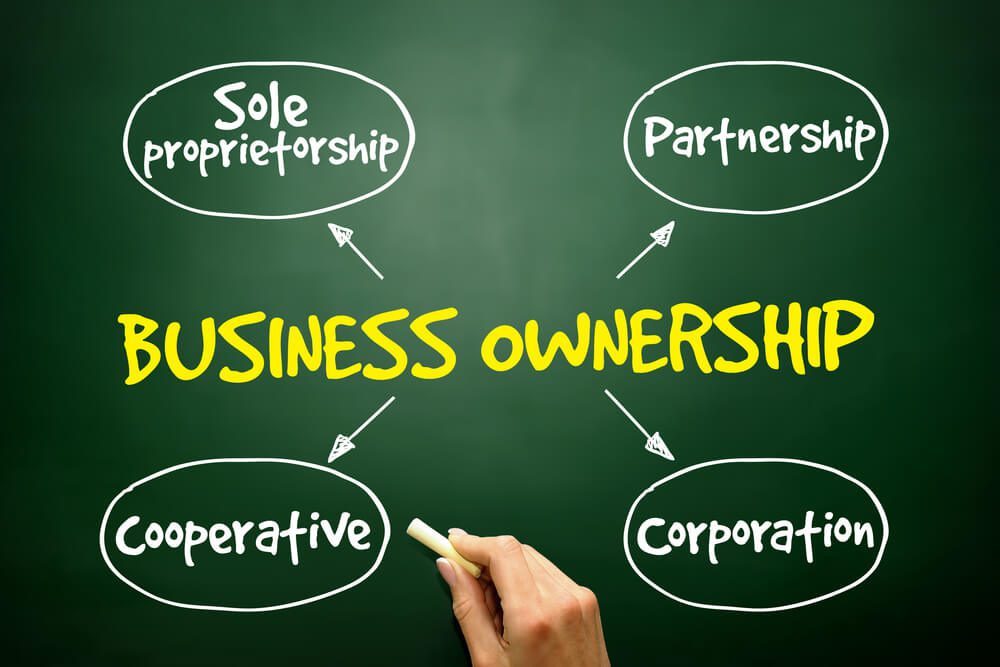
Choosing the right small business structure, such as a sole proprietorship/DBA, LLC, LLP, S-Corp, or others, affects liability protection, taxes, administrative burden, fundraising ability, and growth potential. Selecting wisely can protect personal assets, minimize self-employment taxes, and support scaling, while the wrong choice may expose you to unnecessary risk or higher costs.
Let’s cover the main options for U.S. small businesses, their key benefits, drawbacks, and when each typically makes sense. Rules vary by state, and tax treatment can change, so consult a qualified attorney and CPA for your situation. Formation costs, annual fees, and compliance requirements also differ by location.
Sole Proprietorship and DBA (Doing Business As)
A sole proprietorship is the simplest structure: you and the business are the same legal entity. You can operate under your personal name or file a DBA (fictitious name) for branding.
Benefits
- Extremely easy and low-cost to start (often no state filing required beyond licenses or a DBA).
- Full control and simple taxes – profits and losses report on your personal Form 1040 via Schedule C.
- Eligible for the qualified business income (QBI) deduction in many cases.
- Minimal ongoing paperwork.
Drawbacks
- Unlimited personal liability – business debts, lawsuits, or obligations can reach your home, savings, and other personal assets.
- Harder to raise capital or attract certain clients/partners.
- All net earnings are generally subject to self-employment tax (Social Security and Medicare).
When it makes sense Ideal for low-risk side jobs, freelancers, consultants, or testing a business idea with minimal revenue and few assets at stake. Upgrade once income grows, contracts increase, or personal assets need protection (often when profits reach the $30k–$50k range or liability exposure rises).
Partnerships (General Partnership, Limited Partnership, and LLP)
Partnerships involve two or more owners. A general partnership is informal; limited partnerships (LPs) and limited liability partnerships (LLPs) add formal elements.
Key distinctions
- General partnership: Partners share management and unlimited liability (joint and several).
- Limited partnership: General partners manage and have unlimited liability; limited partners have liability capped at their investment and limited involvement.
- LLP: Provides limited liability protection to all partners, shielding them from many partnership debts and the negligence of co-partners (especially valuable in professional fields).
Benefits
- Pass-through taxation (profits/losses flow to partners’ personal returns; no entity-level federal income tax in most cases).
- Relatively straightforward formation compared with corporations.
- LLPs offer liability protection suitable for multi-owner professional practices.
- Flexible profit-sharing via partnership agreement.
Drawbacks
- General partners face personal liability exposure.
- More complex than a sole proprietorship (need a solid partnership agreement).
- Potential self-employment tax on active partners’ shares.
- LLPs are restricted in some states to licensed professionals (e.g., lawyers, accountants, architects).
When it makes sense Good for multi-owner businesses testing an idea, professional service firms (law, accounting, consulting-often via LLP), or situations where some owners want passive roles (LP). An LLC is frequently preferred over a general partnership for broader liability protection and flexibility.
Limited Liability Company (LLC)
An LLC combines limited liability protection with pass-through taxation flexibility. It is one of the most popular choices for small businesses.
Benefits
- Personal assets are generally protected from business debts and lawsuits (the “corporate veil,” if formalities are maintained).
- Flexible taxation: default pass-through (single-member treated like a sole prop; multi-member like a partnership). Can elect S-Corp or C-Corp taxation.
- Fewer corporate formalities than corporations (no required board meetings or extensive record-keeping in most cases).
- Credibility with clients, banks, and vendors; easier to bring on members or transfer interests via an operating agreement.
- Eligible for QBI deduction in many pass-through scenarios.
Drawbacks
- State filing fees and often annual reports/franchise taxes.
- Self-employment tax typically applies to all active members’ shares under default taxation.
- Some states have higher ongoing costs or restrictions.
When it makes sense The default recommendation for most small businesses with any meaningful liability risk, personal assets to protect, contracts, employees, or growth plans. Excellent for service businesses, product sellers, real estate, and multi-member operations. Many start as an LLC and later elect S-Corp taxation once profitable enough.
S-Corporation (S-Corp)
An S-Corp is primarily a tax election (available to eligible corporations or LLCs) rather than a standalone legal entity. It provides pass-through taxation with potential self-employment tax savings.
Benefits
- Limited liability protection (same as a C-Corp or LLC that elects it).
- Pass-through taxation – no double taxation.
- Owners who work in the business take a reasonable salary (subject to payroll taxes) and can take remaining profits as distributions (generally not subject to self-employment tax). This can produce meaningful savings once profits are high enough.
- Still often eligible for the QBI deduction.
Drawbacks
- Strict IRS eligibility rules (limited number of shareholders – generally 100; one class of stock; U.S. citizens/residents; certain entity restrictions).
- Requires running payroll, filing Form 1120-S, issuing K-1s, and more compliance (higher accounting costs).
- Reasonable compensation must be paid – underpaying salary to maximize distributions invites IRS scrutiny.
- Less flexible for raising outside capital or complex ownership.
When it makes sense Often optimal for profitable, stable service or owner-operated businesses once net profits consistently exceed roughly $50,000–$100,000 (the exact breakeven depends on reasonable salary needs, compliance costs of $1,500–$3,000+, and specific numbers). Many form an LLC first, then elect S-Corp status via Form 2553 when the tax savings outweigh the extra administrative burden. Not ideal if you plan to seek venture capital or have non-qualifying owners.
C-Corporation (and Brief Notes on Other Options)
A C-Corp is a separate taxable entity.
Benefits
- Strong limited liability.
- Unlimited shareholders, multiple stock classes, easier equity incentives, and preferred vehicle for institutional/venture capital.
- Flat 21% federal corporate tax rate on retained earnings (can be advantageous in some growth scenarios).
- Broader fringe benefit options in some cases.
Drawbacks
- Double taxation (corporate tax on profits + shareholder tax on dividends).
- More formalities, higher compliance costs, and less tax flexibility for many small owner-operated businesses.
When it makes sense Primarily for businesses planning significant outside investment, stock options for employees, or an eventual exit/acquisition where C-Corp status is preferred by investors. Most pure small businesses avoid it initially due to double taxation.
Other less common options include nonprofits (for mission-driven organizations seeking tax-exempt status) and cooperatives, but these are specialized.
Quick Comparison and Decision Framework
| Structure | Liability Protection | Taxation | Best For | Complexity/Cost |
| Sole Prop / DBA | None | Pass-through (SE tax on all) | Low-risk testing, freelancers | Lowest |
| General Partnership | None (general partners) | Pass-through | Multi-owner testing | Low |
| LLP | Limited (varies) | Pass-through | Professional multi-partner firms | Medium |
| LLC | Yes | Flexible pass-through (or elect) | Most small businesses needing protection | Medium |
| S-Corp (election) | Yes | Pass-through + salary/distribution split | Profitable owner-operated businesses | Higher |
| C-Corp | Yes | Entity-level + possible double tax | VC-backed or high-growth equity plans | Highest |
Practical guidance
- Start simple (sole prop or single-member LLC) if testing or low-risk.
- Add liability protection early via LLC if you have assets, contracts, or physical operations.
- Consider S-Corp election once profits support a reasonable salary plus meaningful distributions and savings exceed extra costs.
- Factor in state-specific fees, professional restrictions (especially for LLPs), ownership plans, and exit strategy.
- Maintain formalities (separate bank accounts, proper records, adequate capitalization) to preserve liability shields.
Choosing a small business structure is not permanent. You can often convert or elect different tax treatment later, but starting with the right foundation reduces friction and cost. It’s important to review your liability exposure, projected profits, ownership needs, and growth plans with professionals familiar with your state and industry. The optimal structure balances protection, tax efficiency, and operational simplicity for your business.
About the Author
Joseph M. Favorito, CFP® is a Certified Financial Planner® as well as the founder and managing partner at Landmark Wealth Management, LLC, a fee-only SEC registered investment advisory firm. He specializes in helping individuals and families develop comprehensive financial strategies to achieve their long-term goals.