
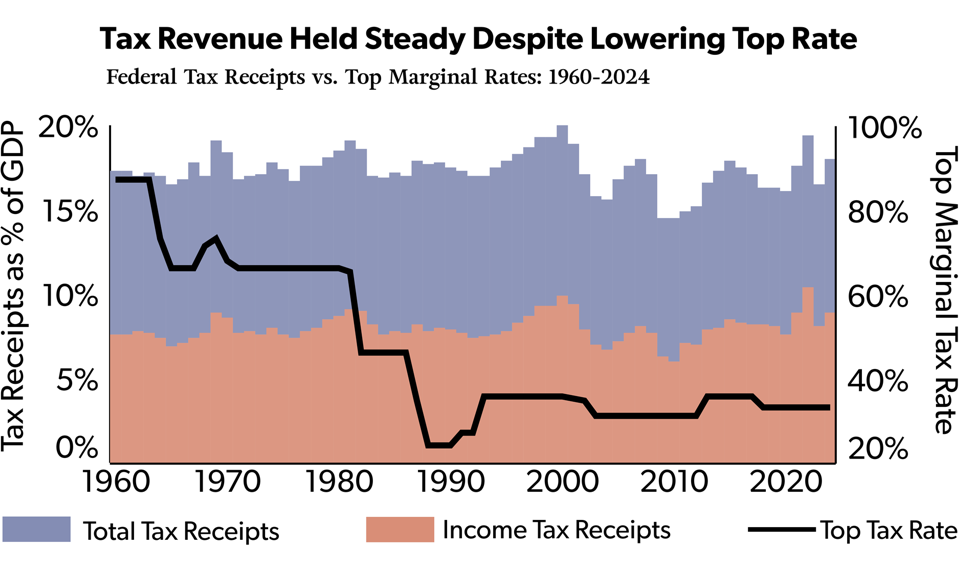
Federal receipts from all sources (individual income taxes, payroll/Social Security and Medicare taxes, corporate income taxes, excises, customs, estate taxes, and other sources) have shown remarkable stability as a share of the economy since World War II. This pattern is often called Hauser’s Law, after investment analyst W. Kurt Hauser, who observed in the 1990s that postwar federal tax revenues hovered around 19.5% of GDP regardless of the marginal rates.
Updated data confirms this core finding. From fiscal year 1946 through the mid-2000s, receipts averaged roughly 17.9% of GDP, with a typical range of about 14–21%. Recent figures remain in the same band: around 16–18% in most years of the 2010s and early 2020s, with 2025 near 17%. Peaks near or slightly above 20% (late 1990s–2000 boom) and troughs near 14–15% (deep recessions like 2009) track the business cycle instead of statutory rate changes.
Top Marginal Rates Swung Wildly; Revenue Share Did Not
The top individual income-tax rate has ranged from 91–92% in the early 1950s down to 28% in the late 1980s, then settled in the mid-to-high 30s in recent decades. Corporate rates, payroll tax rates, and the overall tax code structure also changed substantially. Yet total federal receipts as a percent of GDP showed no sustained upward or downward trend tied to those rate shifts. Individual income-tax revenue itself has typically run in a narrower band around 7–9% of GDP for decades, with total receipts (including the large and relatively stable payroll component) filling out the rest.
This is federal receipts only. Combined federal + state + local government revenues run higher (often in the mid-20s to mid-30s percent of GDP in recent decades) because states and localities rely more on sales, property, and other taxes. The federal pattern is the most relevant for national income-tax rates and many personal financial decisions.
Why the Share Stays Stable
Several forces keep the revenue-to-GDP ratio from tracking marginal rates one-for-one:
- Behavioral responses. Higher marginal rates encourage people and firms to work less (or report less), shift income into lower-taxed forms, increase deductions and credits, delay realizations, or relocate activity. Lower rates tend to expand the taxable base and encourage realization of gains. These responses are the empirical counterpart to the idea behind the Laffer curve: beyond a point, higher statutory rates do not produce proportionally higher revenue.
- Economic growth and the tax base. Revenue is roughly proportional to GDP. Policies that expand the economy tend to raise absolute revenue even if the GDP share stays flat. Rate hikes that slow growth can shrink the base enough to offset much of the rate increase.
- Base-broadening and other policy offsets. Major rate cuts (1980s, 2017) often came with fewer deductions or other base expansions. Rate increases have sometimes been accompanied by new preferences. The net effect on the revenue share is muted.
- Composition of the tax system. Payroll taxes have grown in importance and are relatively inelastic. Progressive income taxes and corporate taxes fluctuate more with the cycle and with high-income realizations, but the overall mix has kept the total share extremely steady.
Short-term deviations occur, booms lift capital-gains and high-income realizations; recessions and temporary tax cuts or credits pull the ratio down, but the long-run mean reasserts itself.
Implications for “Taxes Must Rise” Assumptions
Some investors are taking the planning approach to realize more income today at lower rates, rather than pay a higher percentage later on. This could manifest in many ways, such as realizing a capital gain now as opposed to in the future. Or more commonly to convert a traditional IRA/401(k) to a Roth now because future tax rates “will be higher” due to deficits, entitlement growth, and political pressure. History undercuts the certainty of that assumption in two ways.
First, the federal government has not been able to sustainably collect much more than about 18–20% of GDP in total receipts for a century, even when top rates were far higher and deficits or spending pressures existed. Raising rates have never reliably delivered a permanently higher revenue share. Second, real-world tax reform often pairs base broadening (or new revenue sources) with lower statutory rates rather than simply jacking up marginal rates. Proposals over the years have frequently contemplated lower top brackets alongside fewer deductions or alternative bases. Higher overall tax burdens (if they materialize) therefore do not automatically mean higher marginal rates on ordinary income or retirement distributions.
ROTH Conversions
For Roth conversions specifically, the key variable is the marginal rate at conversion versus the effective rate that will apply to future withdrawals (or the rates that would apply to the same dollars if left in a traditional account). Future statutory rates are uncertain for many reasons: political control changes, economic conditions, demographic shifts, possible base reforms, and the fact that an individual’s own bracket can change with income, filing status, deductions, and required minimum distributions. Treating “rates will rise” as a high-confidence input can lead to over-conversion at today’s rates, especially in higher brackets, or to ignoring time-value-of-money, state taxes, Medicare IRMAA cliffs, and other interactions.
A more robust approach treats rate uncertainty explicitly: partial conversions for tax diversification, careful modeling of true marginal rates (including phase-outs and surtaxes), and recognition that growing the after-tax pie through economic growth has historically been a more reliable path to higher absolute revenue than pushing the GDP share higher.
Important Caveats
Hauser’s Law is an empirical regularity, not an immutable physical law. Extreme policy changes, major shifts in the composition of GDP, or sustained high inflation with unindexed brackets could theoretically alter the pattern. Federal spending has often exceeded the historical revenue share, producing deficits financed by borrowing; the constraint appears tighter on the revenue side than on the spending side. State and local taxes add another layer for many households.
Still, the multi-decade evidence is clear: total federal receipts from all sources have clustered tightly around 17–18% of GDP through very dramatic changes in marginal rates. That history suggests policymakers cannot count on rate hikes to produce a permanently larger share of the economy, and individuals should be cautious about making irreversible personal financial decisions such as a ROTH conversion solely on the premise that future marginal rates must be substantially higher. Growing the economy has been the more consistent route to higher absolute tax revenue, and counting on higher rates is in no way a certainty.
About the Author
Joseph M. Favorito, CFP® is a Certified Financial Planner® as well as the founder and managing partner at Landmark Wealth Management, LLC, a fee-only SEC registered investment advisory firm. He specializes in helping individuals and families develop comprehensive financial strategies to achieve their long-term goals.