
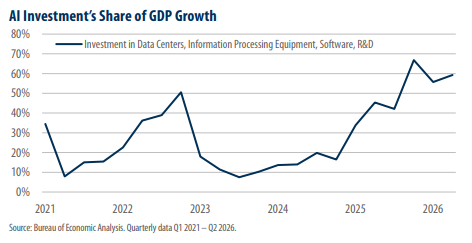
Artificial intelligence is no longer just a technological story; it has become one of the most powerful engines of U.S. economic growth. A chart from the Bureau of Economic Analysis (BEA) reveals that investment in data centers, information processing equipment, software, and research & development now accounts for a dramatically rising share of real GDP growth. From volatile levels in the early 2020s, this AI-related investment share climbed sharply, briefly exceeding 60% and remaining elevated into mid-2026.
This shift carries major implications for investors navigating a market where traditional growth drivers are giving way to technology-led capital spending.
The Chart: AI Capex Takes Center Stage
The BEA data tracks the contribution of key AI-enabling categories, data center construction, computers and peripherals (information processing equipment), software, and R&D, to overall real GDP growth on a quarterly basis from Q1 2021 through Q2 2026.
Early in the period the share fluctuated, dipping near zero at times before surging above 40% in 2022. After another pullback, the spending turned decisively upward from 2023 onward. By late 2025 and into 2026 it reached peaks near or above 60%, underscoring how heavily recent economic expansion has relied on these investments.
Multiple independent analyses confirm the pattern. AI-related categories have frequently accounted for 30–50% (and in some quarters far more) of growth, rivaling or exceeding the contribution seen during the late-1990s dot-com investment boom when measured on comparable bases. Software and servers/data-center equipment have been particularly large drivers.
Why This Matters for the Broader Economy
Several forces explain the surge. Hyperscalers and enterprises have poured capital into the physical and digital infrastructure required to train and run large AI models. Data-center construction, high-performance computing hardware, networking gear, and software platforms have expanded rapidly. R&D spending tied to AI development has added further momentum.
This investment boom has helped keep overall U.S. growth resilient even as other sectors slowed. In periods when consumer spending or traditional business investment softened, AI-related outlays provided a critical offset. Some estimates place the contribution of these categories at 0.5–1 percentage point or more of annual real GDP growth in recent years, depending on the exact definition used.
Important caveats apply. A meaningful portion of the hardware is imported, so the net domestic contribution is lower once imports are subtracted. Measurement challenges also exist, such as semiconductors used as intermediate inputs and certain intangible AI model development costs are not fully captured in standard investment statistics. Still, the directional story is clear: AI infrastructure spending has become a dominant cyclical force.
Implications for Investors in a Changing Market
- Concentration risk and opportunity in the AI value chain
The elevated share of growth means equity market returns have become more tightly linked to a relatively narrow set of companies and themes. Beneficiaries include:
- Hyperscale cloud providers and semiconductor firms supplying AI accelerators
- Data-center REITs, specialized construction and power infrastructure companies
- Software and enterprise AI platform providers
- Utilities and energy firms addressing the surging electricity demand of AI facilities
Investors overweight these areas have generally been rewarded, but the concentration also raises the stakes. Any slowdown in AI capex plans, delays in data-center permitting or power availability, or shifts in model-training economics could produce sharper market reactions than in a more balanced growth environment, or a more balanced portfolio that incorporates further diversification.
- Productivity payoff remains the key long-term variable
Capital spending alone does not guarantee sustained higher growth. The ultimate test is whether these investments translate into measurable productivity gains across the broader economy. Early evidence of productivity acceleration exists in some sectors, yet the full diffusion of AI tools into non-tech industries is still unfolding. Markets that price in rapid, economy-wide productivity lifts may face volatility if realization proves slower or more uneven. - Interest rates, valuations, and crowding-out effects
Heavy AI investment has occurred against a backdrop of higher real interest rates than in the prior decade. This environment favors companies with strong balance sheets and clear paths to monetizing AI infrastructure. At the same time, some research suggests AI spending has partially crowded out other forms of business investment. Investors should monitor whether non-AI capital expenditure remains subdued and how that affects cyclical sectors. - Portfolio construction in an AI-driven cycle
- Maintain exposure to the core AI infrastructure theme while diversifying across the value chain (chips, power, software, real assets).
- Watch leading indicators of capex intensity, hyperscaler capital expenditure guidance, data-center construction spending, and semiconductor equipment orders.
- Stress-test portfolios for scenarios in which AI investment growth moderates after the current build-out phase.
- Consider the secondary effects on energy, real estate, and labor markets, as power constraints and skilled-worker demand continue to shape the opportunity set.
Looking Ahead
The BEA chart illustrates a structural change: AI-related investment has moved from a supporting role to a primary driver of U.S. GDP growth. For investors, this elevates both the upside potential of the AI ecosystem and the importance of disciplined risk management. Markets that once revolved around consumer spending and broad industrial investment are increasingly sensitive to the pace and productivity returns of the AI build-out.
Staying informed on the latest BEA investment data, corporate capital expenditure plans, and early productivity metrics will be essential. In a market where one theme accounts for such a large share of growth, understanding the sustainability of that theme is no longer optional, it is central to long-term portfolio construction and diversification.
About the Author
Joseph M. Favorito, CFP® is a Certified Financial Planner® as well as the founder and managing partner at Landmark Wealth Management, LLC, a fee-only SEC registered investment advisory firm. He specializes in helping individuals and families develop comprehensive financial strategies to achieve their long-term goals.