
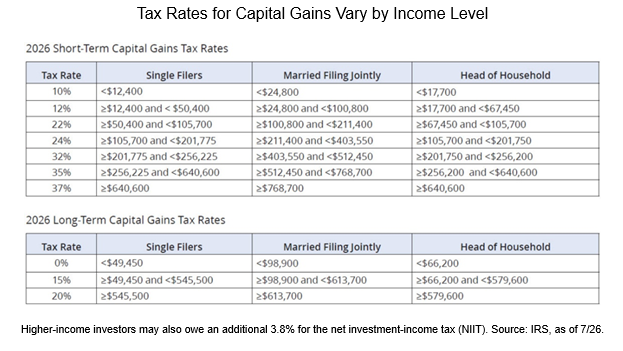
Understanding the 2026 capital gains tax rates is essential for investors, homeowners, and anyone planning to sell assets like stocks, bonds, mutual funds, cryptocurrency, or real estate. Capital gains taxes apply to profits from the sale of investments, and the rate you pay depends heavily on how long you hold the asset, your taxable income, and your filing status.
Here’s a clear breakdown of the short-term and long-term capital gains tax rates, plus the additional Net Investment Income Tax (NIIT) that can apply to higher earners.
Short-Term Capital Gains Tax Rates for 2026
Short-term capital gains apply to assets held for one year or less. These gains are taxed as ordinary income at the same rates as your wages or salary.
2026 Short-Term Capital Gains Tax Rates
| Tax Rate | Single Filers | Married Filing Jointly | Head of Household |
| 10% | <$12,400 | <$24,800 | <$17,700 |
| 12% | ≥$12,400 and <$50,400 | ≥$24,800 and <$100,800 | ≥$17,700 and <$67,450 |
| 22% | ≥$50,400 and <$105,700 | ≥$100,800 and <$211,400 | ≥$67,450 and <$105,700 |
| 24% | ≥$105,700 and <$201,775 | ≥$211,400 and <$403,550 | ≥$105,700 and <$201,750 |
| 32% | ≥$201,775 and <$256,225 | ≥$403,550 and <$512,450 | ≥$201,750 and <$256,200 |
| 35% | ≥$256,225 and <$640,600 | ≥$512,450 and <$768,700 | ≥$256,200 and <$640,600 |
| 37% | ≥$640,600 | ≥$768,700 | ≥$640,600 |
Long-Term Capital Gains Tax Rates for 2026
Long-term capital gains apply to assets held for more than one year. These receive preferential tax treatment with significantly lower rates (0%, 15%, or 20%).
2026 Long-Term Capital Gains Tax Rates
| Tax Rate | Single Filers | Married Filing Jointly | Head of Household |
| 0% | <$49,450 | <$98,900 | <$66,200 |
| 15% | ≥$49,450 and <$545,500 | ≥$98,900 and <$613,700 | ≥$66,200 and <$579,600 |
| 20% | ≥$545,500 | ≥$613,700 | ≥$579,600 |
Additional 3.8% Net Investment Income Tax (NIIT)
Higher-income investors may also owe an extra 3.8% Net Investment Income Tax on top of the regular capital gains rates. This is also known as the “Obamacare tax” which was designed to aid the funding of the Affordable Care Act (ACA). This surtax applies to the lesser of your net investment income or the amount by which your modified adjusted gross income exceeds certain thresholds (typically $200,000 for single filers and $250,000 for joint filers). The NIIT can push the effective long-term capital gains rate as high as 23.8% for top earners.
Key Takeaways for Investors in 2026
- Holding period matters: Selling after more than one year can drop your tax rate from as high as 37% (plus NIIT) down to 0–20%.
- Income level drives the rate: Even long-term gains can be taxed at 20% once your taxable income crosses the higher thresholds shown above.
- Filing status differences: Married couples filing jointly generally enjoy wider brackets before higher rates apply.
- Planning opportunities: Strategies such as tax-loss harvesting, timing of asset sales, contributing to retirement accounts, or gifting appreciated assets can help manage exposure to these rates.
These 2026 figures are inflation-adjusted and based on IRS data as of September 2026. Much like ordinary income tax rates, the thresholds for various tax rates typically get adjusted each year for inflation. Always verify the latest official IRS guidance or consult a qualified tax professional or financial advisor, as individual circumstances, state taxes, and other factors can affect your actual liability.
Proper planning around capital gains taxes remains one of the most effective ways to keep more of your investment returns. A solid understanding of your tax circumstances can potentially create opportunities to mitigate tax liability via various strategies such as tax loss harvesting. Always remember, it’s not what you make, but what you keep.
About the Author
Joseph M. Favorito, CFP® is a Certified Financial Planner® as well as the founder and managing partner at Landmark Wealth Management, LLC, a fee-only SEC registered investment advisory firm. He specializes in helping individuals and families develop comprehensive financial strategies to achieve their long-term goals.