
Inflation quietly erodes purchasing power year after year. For long-term investors, the critical question is not simply “Did my portfolio grow?” but “Did it grow faster than the cost of living?”
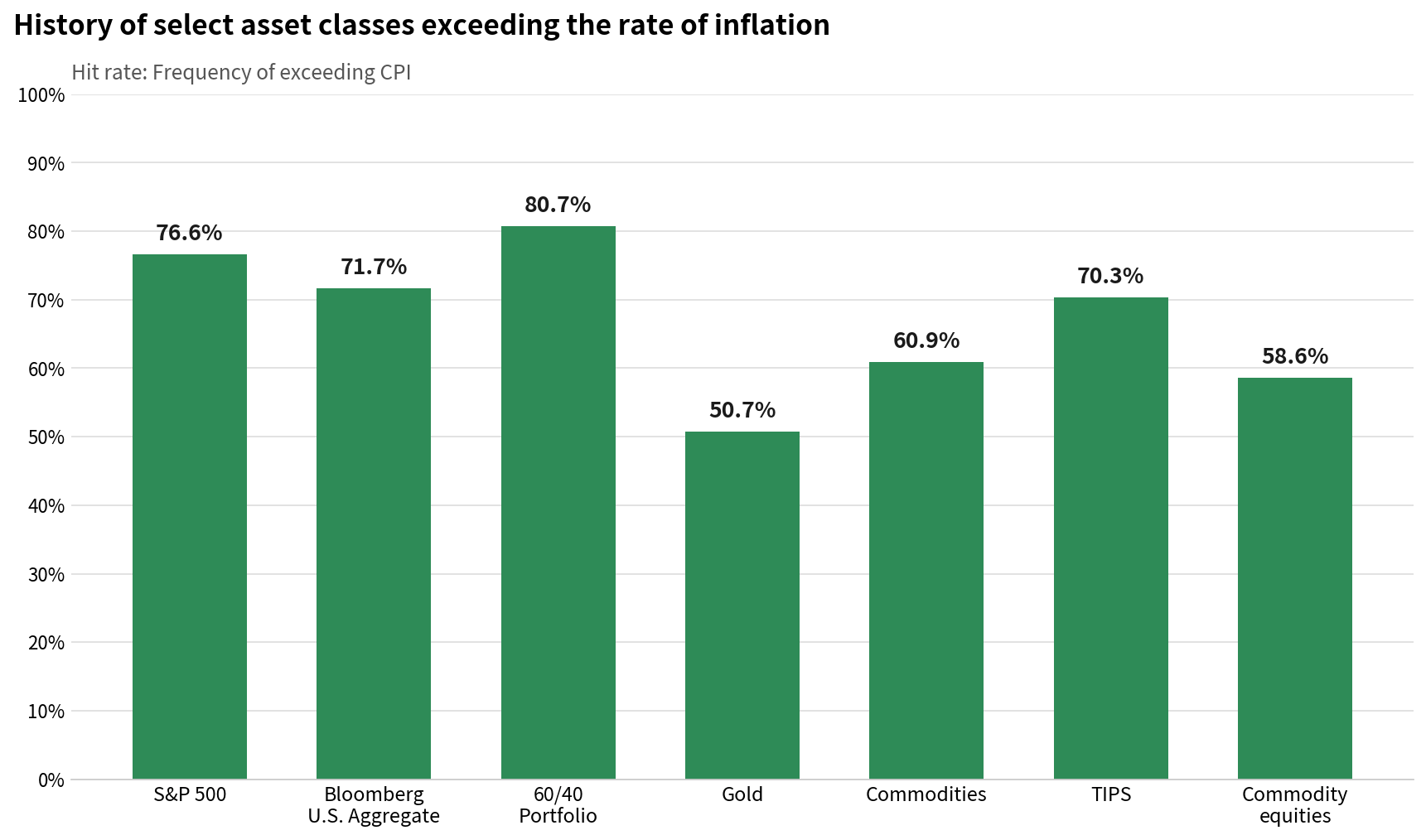
A useful way to measure this is the hit rate, the percentage of historical periods in which an asset class delivered a total return higher than the Consumer Price Index (CPI). The chart above provided by Fidelity Investments research summarizes that track record across seven widely followed asset classes and portfolios.
Key Takeaways from the Data
- 60/40 Portfolio leads with an 80.7% hit rate. A classic balanced allocation of 60% equities and 40% fixed income has beaten inflation more frequently than any of the individual asset classes shown. The combination of equity growth and bond income/diversification has historically provided the most consistent real returns.
- U.S. equities (S&P 500) follow closely at 76.6%. Stocks have been one of the most reliable long-term inflation hedges, though they experience more short-term volatility than a balanced portfolio.
- Bloomberg U.S. Aggregate Bond Index posts a solid 71.7%. Intermediate-term investment-grade bonds have outpaced CPI more often than many investors expect, particularly in environments where rates were higher or falling.
- TIPS (Treasury Inflation-Protected Securities) come in at 70.3%. These securities are explicitly designed to protect against inflation, and the data confirms they have done so in roughly seven out of ten periods.
- Commodities (60.9%) and commodity equities (58.6%) have provided inflation protection roughly three-fifths of the time. Their performance tends to be more cyclical and concentrated in specific inflation regimes (energy spikes, supply shocks, etc.).
- Gold has the lowest hit rate among the group at 50.7%. While gold is often marketed as an inflation hedge, the historical frequency of beating CPI is only slightly better than a coin flip. Gold has shone in certain high-inflation or crisis periods, but it has underperformed the CPI nearly half the time over the full history examined.
What This Means for Portfolio Construction
No single asset class is a perfect inflation hedge in every period. The data underscores two practical points:
- Diversification improves consistency. The 60/40 portfolio’s superior hit rate illustrates the power of combining growth assets with stabilizers. Investors who rely solely on one “inflation fighter” (gold, commodities, or even pure equities) accept greater period-to-period uncertainty.
- Equities remain the primary long-term engine. Stocks have beaten inflation in roughly three out of four periods. For investors with multi-decade horizons, a meaningful equity allocation continues to be the most reliable way to grow purchasing power.
- Bonds and TIPS still matter. Even though equities lead, fixed-income exposure, especially inflation-linked securities has contributed meaningfully to real-return consistency and has helped reduce drawdowns.
Practical Implications for Investors
- Focus on real (after-inflation) returns rather than nominal performance alone.
- Maintain a strategic equity allocation appropriate to your time horizon and risk tolerance.
- Consider a diversified core (such as a 60/40 or similar balanced approach) as the foundation, then layer in targeted inflation-sensitive assets.
- Revisit allocations periodically. Inflation regimes change, and so does the relative effectiveness of different hedges.
Inflation will remain a permanent feature of the economic landscape. The historical record shows that a thoughtfully diversified portfolio anchored by equities and balanced with fixed income has been the most consistent way to stay ahead of inflation and grow wealth.
About the Author
Joseph M. Favorito, CFP® is a Certified Financial Planner® as well as the founder and managing partner at Landmark Wealth Management, LLC, a fee-only SEC registered investment advisory firm. He specializes in helping individuals and families develop comprehensive financial strategies to achieve their long-term goals.