
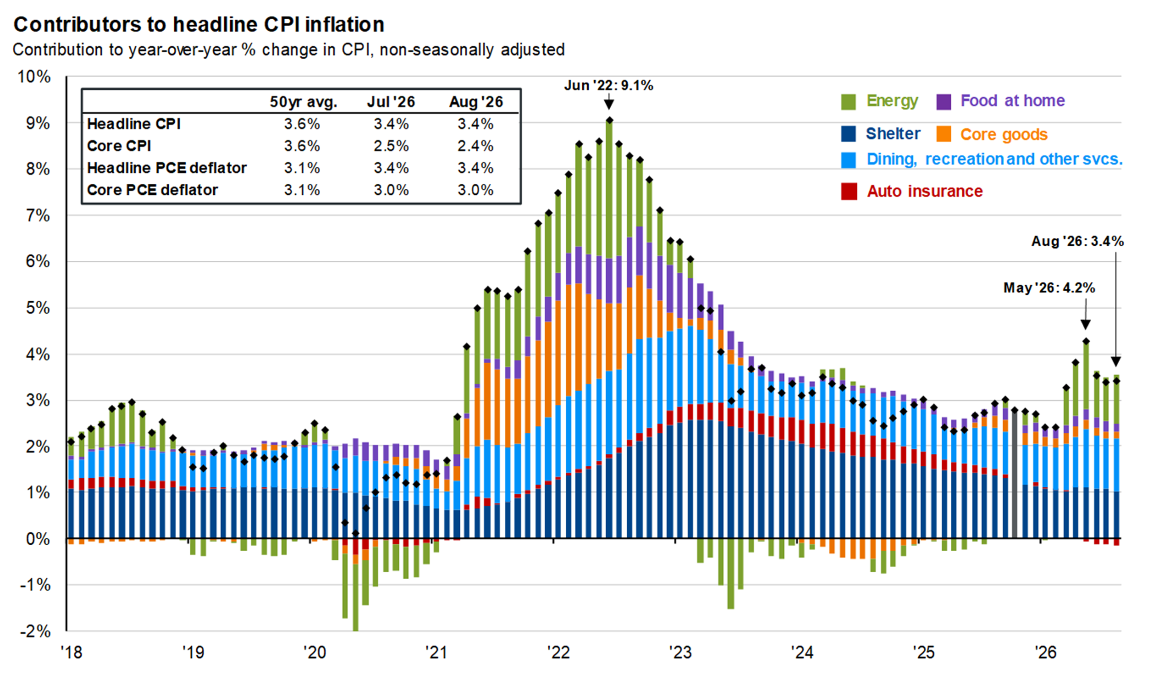
Headline consumer price inflation in the United States has declined substantially from its mid-2022 peak, yet a recent surge in energy costs tied to the ongoing war involving Iran has prevented a full return to the Federal Reserve’s preferred levels. This detailed breakdown of contributors to year-over-year CPI changes courtesy of JP Morgan illustrates how shelter, core goods, food, and services have moderated down, while energy has reasserted itself as a dominant upward force in 2026.
Understanding Headline CPI, Core CPI, and the PCE Price Indexes
Headline CPI tracks the year-over-year change in prices for a fixed basket of goods and services purchased by urban consumers and includes every category, making it sensitive to swings in food and energy. Core CPI strips out those two volatile components to reveal underlying inflation trends that policymakers often view as more persistent. The Personal Consumption Expenditures (PCE) price index, also called the PCE deflator, is the Federal Reserve’s preferred gauge, as it covers a broader set of expenditures, including those by rural households and nonprofit institutions. It uses continuously updated weights that they believe better reflects actual spending patterns and typically runs a bit lower than CPI. Core PCE, which likewise excludes food and energy, is the measure the Fed watches most closely when assessing progress toward its 2% longer-run inflation goal.
From 9.1% Peak to 3.4% in August 2026
The accompanying stacked bar chart tracks the contribution of major categories to the year-over-year percentage change in the non-seasonally adjusted Consumer Price Index from early 2018 through August 2026. Headline CPI peaked at 9.1% in June 2022 amid the post-pandemic recovery, supply-chain disruptions, and a dramatic expansion of the money supply in 2021. Contributions from energy (green bars), food at home (purple), shelter (dark blue), core goods (orange), dining/recreation and other services (light blue), and auto insurance (red) all stacked higher during that period.
Since then, the overall rate has trended lower. By May 2026 it stood at 4.2%, and by August 2026 it had eased to 3.4%. Core CPI (excluding food and energy) reached 2.4% in August, while the headline and core PCE deflators both registered 3.4% and 3.0%, respectively. These figures sit close to the 50-year averages of roughly 3.6% for headline and core CPI and 3.1% for the PCE measures, signaling a broad cooling after the extreme volatility of 2021–2023.
Shelter and Services Stabilize; Energy Reverses the Trend
Shelter has remained a steady positive contributor throughout the period, reflecting the large weight of housing in the CPI basket, but its relative impact has diminished as rent and owners’ equivalent rent growth slowed. Core goods, which spiked sharply in 2021–2022 due to durable-goods demand and shortages, have largely normalized and even turned modestly negative at times. Food-at-home contributions moderated after earlier volatility, and dining, recreation, and other services have shown a gradual tapering.
The big notable exception is energy. Green bars that were often negative or modest in 2023–2025 turned sharply positive in 2026. Official data confirm that energy prices rose 16.3% over the 12 months ending August 2026, with gasoline up more than 27% and fuel oil even higher. This rebound accounts for a substantial share of the gap between headline CPI at 3.4% and core CPI at 2.4%.
Iran Conflict Drives the Energy Exception
The recent energy-price acceleration is largely attributable to the war that began in early 2026 involving Iran, the United States, and other related regional nations. Disruptions to oil flows through the Strait of Hormuz, attacks on energy infrastructure, and related supply constraints pushed crude prices significantly higher from pre-conflict levels near $65–$70 per barrel. Global markets have faced reduced Middle East exports at various points, elevated risk premiums, and secondary effects on diesel and refined products. These dynamics have fed directly into U.S. pump prices and the energy component of the CPI, offsetting progress elsewhere in the index.
While other categories have continued to cool, consistent with tighter monetary policy earlier in the cycle and easing supply bottlenecks, the energy shock has kept headline inflation elevated relative to core measures. Auto insurance contributions, visible in red, have also fluctuated but remain secondary to the energy and shelter dynamics.
Implications for Policy and Markets
The chart underscores a familiar pattern: volatile energy and food components can mask underlying progress in core inflation. With core CPI near multi-year lows and close to longer-run averages, underlying price pressures appear more contained than the headline figure suggests. However, sustained elevated energy costs raise the risk of second-round effects on transportation, goods, and services if the conflict persists or intensifies.
Investors and policymakers will continue to watch whether energy contributions subside as supply routes stabilize or whether further geopolitical escalation prolongs the inflationary impulse. For individual households, the divergence means grocery and housing relief has been more tangible than relief at the gas pump. The data through August 2026 show clear disinflation across most of the CPI basket since the 2022 peak, tempered by an energy-driven exception rooted in the Iran-related conflict.
This composition of inflation moderating core and services contributions alongside a geopolitically driven energy spike remains the central story of the U.S. price landscape in late 2026. This likely means if we see a quicker resolution to the Iran conflict, the current dynamics suggest the headline CPI number will also moderate. However, if the conflict persists, there can be some second and third order effects in the longer run on the core prices.
About the Author
Joseph M. Favorito, CFP® is a Certified Financial Planner® as well as the founder and managing partner at Landmark Wealth Management, LLC, a fee-only SEC registered investment advisory firm. He specializes in helping individuals and families develop comprehensive financial strategies to achieve their long-term goals.