
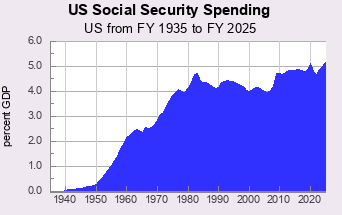
Millions of Americans worry about Social Security’s future after the 2026 Trustees Report projected the Old-Age and Survivors Insurance (OASI) trust fund could deplete reserves in late 2032. Under current law, that would trigger automatic across-the-board reductions of about 22% for retirement benefits (paying 78% of scheduled amounts), or roughly 17% on a combined OASI + Disability Insurance basis in 2034. Yet for people already receiving benefits, and those set to claim in the next few years, large cuts remain unlikely. Here’s the clear financial and political rationale.
The Projected Shortfall Is Real-but Not Inevitable
Social Security operates on a pay-as-you-go model funded mainly by payroll taxes. The 2026 Trustees Report confirms that costs have exceeded non-interest income for years, and reserves are being drawn down. By the fourth quarter of 2032, the OASI fund is projected to run dry under intermediate assumptions. Ongoing tax revenue would still cover the majority of benefits, but not 100% of scheduled amounts without legislation.
This is a cashflow and demographic challenge. Meaning fewer workers per beneficiary, longer lifespans, with lower fertility and immigration assumptions, not an imminent collapse that ends payments. The Disability Insurance fund remains solvent for decades, and combined reserves last until 2034. Importantly, no reductions are in effect today. Annual cost-of-living adjustments continue (2.8% for 2026), and full scheduled benefits are being paid.
Historical Precedent Shows Congress Acts Before the Cliff
Social Security has faced financing pressures before. The most significant was in the early 1980s, when reserves were projected to deplete within years. Congress responded with the 1983 amendments: gradual increases in the full retirement age (affecting future cohorts), higher payroll taxes, taxation of benefits for higher-income recipients, and other adjustments. Benefits for those already receiving checks were largely protected.
Lawmakers have repeatedly demonstrated that allowing abrupt, across-the-board cuts to current retirees is politically untenable. The pattern is consistent: projections create urgency, commissions or bipartisan talks form, and reforms are enacted or the trajectory is altered before automatic reductions hit. Recent months have seen renewed bipartisan activity, including bills to create fast-track commissions or advisory processes aimed at producing solvency plans before 2032.
Political Reality Strongly Protects Current and Near-Term Beneficiaries
Seniors and near-retirees vote at high rates. Cutting the monthly checks of people who have already paid into the system for decades, and who rely on those payments for a large share of retirement income carries severe electoral risk for both parties.
White House statements have repeatedly emphasized protecting and strengthening Social Security with “zero reductions” to payments under current leadership. Advocacy groups, AARP, and lawmakers across the spectrum routinely frame any solution around preserving benefits for those already collecting or about to claim. Polling consistently shows broad public support for maintaining the program without cuts to existing beneficiaries.
Reform discussions almost always distinguish between current recipients (and those close to claiming) versus younger workers still decades from eligibility. Changes that affect people already in or near retirement, such as sudden percentage reductions are the least politically viable options.
Legal Structure of Social Security
Social Security (OASI and DI) is financed by dedicated payroll taxes, interest on the trust fund reserves, and a small amount of income taxation of benefits. By law:
- The trust funds can only spend what they have in dedicated revenues plus accumulated reserves.
- Once the reserves are depleted, benefits must automatically drop to the level supportable by ongoing tax income, currently projected at about 78–83% of scheduled amounts.
- The program is not authorized to borrow from the general fund of the Treasury or receive direct appropriations in the normal course of operations. Changing that would require new legislation.
So, under current law, “printing money” is not an available tool for Social Security specifically.
In theory, Congress could change the law to allow general revenue financing of Social Security (or direct transfers), and those general revenues themselves could be financed by more Treasury borrowing that the Fed helps absorb. That is economically possible. It is not currently legal for Social Security, and it is not costless, as “printing money” comes with inflation risks.
Typical Reform Paths Spare Today’s Checks
Most credible solvency proposals focus on a mix of revenue increases and adjustments that phase in overtime for future retirees. Common elements include:
- Gradually raising or eliminating the taxable wage cap so higher earners contribute more.
- Modest payroll tax rate increases.
- Raising the full retirement age further for younger cohorts.
- Adjusting the benefit formula for high lifetime earners.
- Modifying cost-of-living adjustments or taxation of benefits in progressive ways.
These approaches can close much or all of the long-term gap while leaving the benefit levels of current recipients and near-retirees largely intact. Waiting until the last minute would force larger changes concentrated on fewer people; acting earlier spreads the burden and makes protecting existing benefits easier.
Near-retirees, those planning to claim in the next 5–7 years are generally treated similarly to current beneficiaries in these frameworks. Their benefits are already largely “locked in” based on earnings history, and political incentives favor shielding them from sudden reductions.
The Impact of Life Expectancy & Longevity
It’s important to remember that when Social Security was first enacted, the average American life expectancy was 61.7 years of age. Today that is 79 years of age. That is a more than 17-year increase in life expectancy, while at the same time full retirement age has only grown from age 65 to age 67, which was a gradual increase in benefit ages enacted in 1983.
Most of the historical gains in life expectancy at birth came from large reductions in infant and childhood mortality. Gains at older ages, which is a measurement of longevity, and more relevant to Social Security have also been significant: someone reaching age 65 today can expect roughly 19–20 more years of life on average, compared with about 12–13 years in the 1930s/1940s.
Clearly, the program has not kept up with lifespans, which is why it faces solvency problems today. As much as many of the above proposals are unpopular, they are highly likely to occur in some combination. The most likely of which is an increase in the age at which benefits can be received.
What This Means Practically
If you are already receiving Social Security or will claim soon:
- Full scheduled benefits, including COLAs, continue under current law until the projected depletion dates.
- Automatic across-the-board cuts are the default only if Congress takes no action, an outcome history and politics make improbable.
- Any eventual legislation is far more likely to include transition rules or protections for people already on the rolls or close to claiming than to impose deep, immediate reductions on them.
The program still requires congressional action to remain fully solvent over the long term. Demographic and economic pressures are real, and delays make solutions harder. But the combination of historical precedent, intense political incentives, public support, and the structure of most reform ideas point strongly against large benefit cuts for current recipients and those about to collect.
If you have concerns, stay informed via the annual Trustees Reports and official SSA communications. For personal planning, focus on your full earnings record, optimal claiming age, and overall retirement income sources rather than assuming dramatic near-term reductions that politics and history suggest are unlikely to materialize.
About the Author
Joseph M. Favorito, CFP® is a Certified Financial Planner® as well as the founder and managing partner at Landmark Wealth Management, LLC, a fee-only SEC registered investment advisory firm. He specializes in helping individuals and families develop comprehensive financial strategies to achieve their long-term goals.