
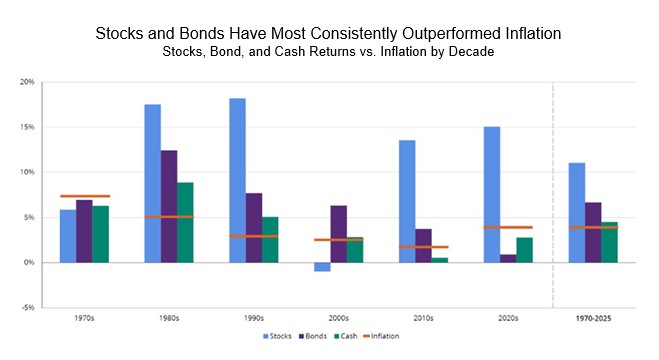
Inflation is one of the biggest threats to long-term wealth. Yet data spanning more than 50 years reveals a clear pattern: stocks and bonds have most consistently outperformed inflation. A detailed bar chart comparing annualized returns of stocks, bonds, cash, and inflation by decade (1970s through 2020s, plus the full 1970–2025 period) highlights this powerful investment truth.
Whether you’re a new investor or seasoned portfolio manager, understanding these historical trends can help you build a strategy that protects and grows your purchasing power over time.
What the Chart Reveals: Stocks, Bonds, Cash & Inflation by Decade
The chart above courtesy of Hartford Funds tracks annualized returns across key asset classes against the inflation rate:
- Stocks (blue bars)
- Bonds (purple bars)
- Cash (green bars)
- Inflation (orange line)
Key observations:
- Stocks delivered the strongest performance in most decades, especially the 1980s, 1990s, 2010s, and 2020s, frequently posting double-digit average annual returns.
- Bonds showed remarkable consistency, outperforming inflation in nearly every period and providing ballast during volatile times.
- Cash (savings, money market, T-bills) barely kept pace with or fell short of inflation in several decades, highlighting the erosion of purchasing power in low-risk holdings.
- The full-period average (1970–2025) confirms the long-term advantage: stocks and bonds both comfortably beat inflation, while cash returns were closer to the inflation line.
Decade-by-Decade Breakdown
1970s: High inflation environment. Stocks and cash struggled to keep up, but bonds held relatively steady.
1980s & 1990s: Golden eras for stocks with strong bull markets. Bonds also posted solid gains amid falling interest rates.
2000s: The “lost decade” for stocks due to the dot-com bust and financial crisis, but bonds still outperformed inflation.
2010s & 2020s: Stocks roared back with strong recoveries and economic expansion. Bonds remained resilient despite low yields for much of the period.
Overall (1970–2025): Stocks led with the highest returns, followed by bonds. Both significantly outpaced inflation, underscoring the importance of owning productive assets.
Why Do Stocks and Bonds Beat Inflation?
- Stocks (Equities) represent ownership in companies that can raise prices, increase productivity, and grow earnings, naturally hedging against inflation.
- Bonds (especially government and high-quality corporates) provide fixed income streams. When inflation is high, central banks often raise rates, which can benefit new bond buyers, while existing bonds still offer stability.
- Cash earns minimal interest that often fails to match inflation, leading to negative real returns over time.
Investment Lessons for Today’s Investors
- Diversification across stocks and bonds has historically been one of the most reliable ways to combat inflation.
- Time in the market beats timing the market – the multi-decade view smooths out short-term volatility.
- Even in challenging decades (like the 2000s), bonds provided a cushion.
- With inflation still a concern in the post-pandemic era, maintaining exposure to real assets and equities remains a proven strategy.
Final Thoughts
The data is clear: stocks and bonds have most consistently outperformed inflation across economic cycles. While past performance doesn’t guarantee future results, the long-term track record strongly favors investors who stay disciplined and maintain a balanced allocation rather than parking everything in cash.
About the Author
Joseph M. Favorito, CFP® is a Certified Financial Planner® as well as the founder and managing partner at Landmark Wealth Management, LLC, a fee-only SEC registered investment advisory firm. He specializes in helping individuals and families develop comprehensive financial strategies to achieve their long-term goals.