
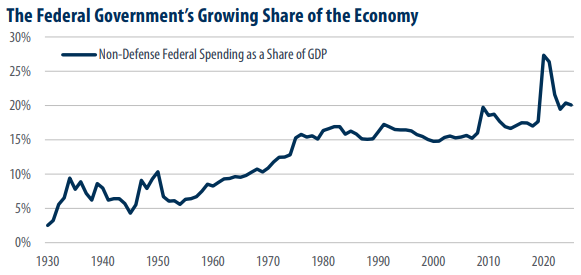
Since 1930, nominal U.S. GDP has surged 309-fold. Yet federal spending has skyrocketed more than 2,111-fold, a stark illustration of government’s dramatically expanding role in the American economy. Stripping out defense provides the clearest view of this structural shift. In 1930, non-defense federal spending stood at just 2.5% of GDP and remained below 10% for the next three decades, with only a brief breach around 1950. That changed dramatically with President Lyndon B. Johnson’s Great Society programs launched in 1964. Spending broke above 10% of GDP by 1967 and never looked back, climbing rapidly through the 1970s and early 1980s.
While growth moderated somewhat under Presidents Reagan and Clinton, the restraint proved temporary. The 2008 Financial Crisis and especially the COVID-19 pandemic drove sharp new increases. As of 2025, non-defense federal spending stands at 20.1% of GDP, a historic high in peacetime.
The Transformation into a Transfer Society
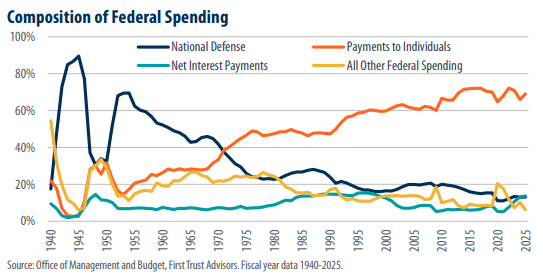
The modern federal budget has been fundamentally reshaped. In 2025, the U.S. government will direct an astonishing $4.8 trillion, 69.0% of total federal spending toward direct payments for individuals. These transfers, delivered as cash, healthcare benefits, retirement income, and other support, now dominate the budget.
This marks a profound evolution: America has become what many analysts call a transfer society, where the primary function of federal spending is moving resources from taxpayers and borrowers to individuals and households.
National Defense, which once dominated the budget, shrunk to just 13.1% of total federal spending in 2025, continuing a steady decline since the mid-1950s. Meanwhile, net interest payments on the national debt reached 13.8% of spending in 2025 and are projected to climb further to 14.7% by 2031. All other federal spending (including infrastructure, education, research, and other discretionary programs) accounts for a modest 6.2% of the budget.
What’s Driving Payments to Individuals?
Two major categories now account for the overwhelming majority of these transfers:
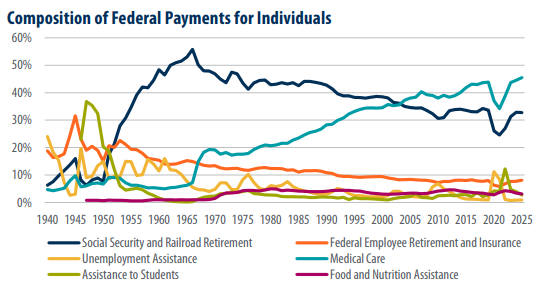
- Medical Care leads the way at $2.20 trillion in 2025, representing 45.5% of all federal payments to individuals. In 1940, medical spending made up only about 5% of such payments. The explosion reflects the growth of Medicare, Medicaid, and rising healthcare costs.
- Social Security and Railroad Retirement follows at $1.58 trillion, or 32.7% of payments to individuals.
Together, these two categories alone make up over three-quarters of all federal payments to individuals. Rounding out the top three is Federal Employee Retirement and Insurance at $392 billion.
Why This Matters for the Economy and Investors
The long-term data reveals more than just numbers, it shows a fundamental reorientation of government priorities. What began as a limited safety net has grown into the central pillar of federal spending. This shift carries significant implications:
- Fiscal Sustainability: With entitlements and interest payments consuming ever-larger shares of the budget, pressure on future deficits and debt will intensify.
- Economic Incentives: Large-scale transfer programs influence labor participation, savings behavior, and private-sector growth.
- Market Implications: Healthcare and senior-related sectors may continue to benefit from structural tailwinds, while rising interest costs and potential future tax increases or entitlement reforms create ongoing policy and market risks.
Bottom Line: The federal government’s role in the U.S. economy has expanded dramatically since the 1930s, and especially since the mid-1960s. Non-defense spending has risen from 2.5% of GDP to 20.1%, driven overwhelmingly by payments to individuals that now total $4.8 trillion annually. As medical care and Social Security dominate an ever-larger share of the budget, understanding these trends is essential for investors, policymakers, and anyone concerned about America’s long-term fiscal health and economic trajectory.
Long-Term Economic Implications and the Inevitable Reckoning via Debt Markets
Over the long term, this relentless expansion of federal transfers, particularly entitlement-driven medical care and Social Security spending threatens to crowd out private investment, reduce incentives for work and savings, and weigh on overall economic growth. As non-defense spending consumes over 20% of GDP and total federal outlays approach or exceed 25-30% in coming years, sustained large deficits will drive the national debt even higher. This dynamic is already visible in rising net interest payments, which hit 13.8% of federal spending in 2025 and are projected to reach 14.7% by 2031.
Crucially, the debt markets will likely force eventual change. As investors grow concerned about fiscal sustainability, they will demand higher yields on U.S. Treasuries to compensate for elevated debt levels and potential inflation risks. The resulting spike in borrowing costs would accelerate the interest burden, creating a vicious feedback loop that squeezes discretionary spending and makes current entitlement trajectories mathematically unsustainable. At that point, policymakers will face unavoidable choices: meaningful entitlement reform, broad-based tax increases, or significant spending restraint, adjustments the markets, rather than political preference, will ultimately compel.
Data sources: Office of Management and Budget and supporting fiscal analyses through 2025 & First Trust.
About the Author
Joseph M. Favorito, CFP® is a Certified Financial Planner® as well as the founder and managing partner at Landmark Wealth Management, LLC, a fee-only SEC registered investment advisory firm. He specializes in helping individuals and families develop comprehensive financial strategies to achieve their long-term goals.