
Investors with highly concentrated stock positions, often from equity compensation, business sales, or long-term holdings, face a difficult tradeoff: diversify and trigger taxes, or hold and accept risk. One increasingly sophisticated solution is the 130/30 strategy, which can simultaneously enhance tax loss harvesting opportunities and help gradually diversify concentrated holdings.
This article breaks down how a 130/30 strategy works, why it’s effective for tax management, and how it can be applied in real-world portfolio construction.
What Is a 130/30 Strategy?
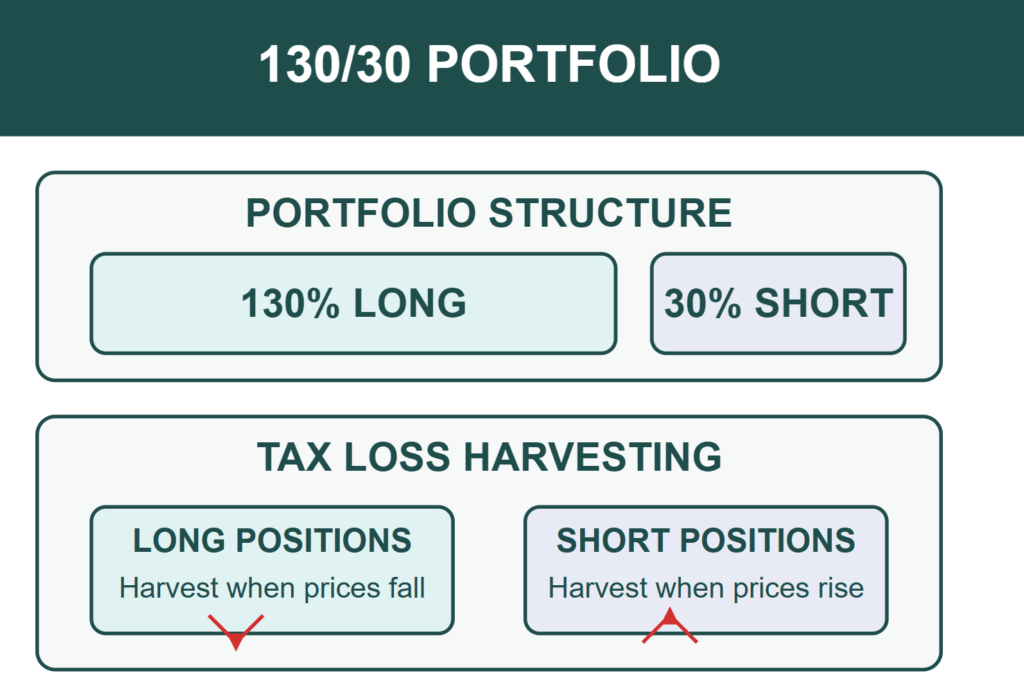
A 130/30 strategy is an extension of traditional long-only investing. Instead of simply allocating 100% of capital to long positions, the portfolio manager:
- Goes 130% long (buys securities expected to outperform)
- Goes 30% short (sells borrowed securities expected to underperform)
The proceeds from the short sales fund the additional long exposure, keeping the net market exposure at 100%.
Key Characteristics:
- Maintains equity-like market exposure
- Introduces active long/short positioning
- Enhances tax management flexibility
- Provides additional sources of return (alpha)
Why Concentrated Stock Positions Are a Problem
Holding a large position in a single stock can create:
- Idiosyncratic risk (company-specific exposure)
- Tax constraints (large embedded capital gains)
- Emotional bias (attachment to a legacy holding)
Selling outright may trigger substantial capital gains taxes, especially for long-term appreciated assets. This is where a 130/30 strategy becomes particularly valuable.
How a 130/30 Strategy Helps Diversify Without Immediate Liquidation
Instead of selling the concentrated position outright, a 130/30 structure allows investors to:
- Maintain the Core Position
The concentrated stock can remain part of the portfolio, avoiding immediate tax realization.
- Overlay Active Long/Short Positions
The manager builds:
- Long positions in diversified equities
- Short positions in overvalued or correlated securities
This effectively dilutes the concentration risk without requiring a full liquidation.
- Reduce Effective Exposure
Even if the concentrated stock remains, the broader portfolio reduces its relative weight and risk contribution.
The Tax Loss Harvesting Advantage
The most powerful feature of a 130/30 strategy is its ability to systematically generate tax losses.
How It Works:
- Short Positions Create Natural Loss Opportunities
Short positions frequently produce realized losses due to market volatility and active trading.
- These losses can be harvested throughout the year
- They are often short-term losses, which are more valuable for tax offset purposes
- High Turnover = More Harvesting Opportunities
Unlike passive portfolios, a 130/30 strategy typically involves:
- Frequent rebalancing
- Active security selection
- Continuous replacement of positions
This leads to a steady stream of realized gains and losses, increasing the probability of harvesting losses.
- Offsetting Gains from Concentrated Positions
Harvested losses can be used to offset:
- Gains from partial sales of the concentrated stock
- Gains generated within the long portfolio
- Up to $3,000 of ordinary income annually (with carryforward benefits)
Accelerating Diversification Through Tax Efficiency
A well-structured 130/30 strategy allows for gradual diversification of a concentrated position in a tax-aware manner.
Step-by-Step Approach:
- Implement 130/30 Overlay
- Maintain concentrated stock
- Introduce long/short framework
- Harvest Losses from Short Book
- Capture losses as markets fluctuate
- Build a “tax loss bank”
- Strategically Sell Concentrated Shares
- Use harvested losses to offset gains
- Reduce tax impact of sales
- Reinvest Into Diversified Holdings
- Increase exposure to broader sectors
- Lower single-stock risk over time
Additional Benefits of a 130/30 Strategy
Enhanced Risk Management
- Reduces dependence on a single stock
- Allows hedging via short positions
Potential for Alpha Generation
- Gains from both long and short selections
- More tools than traditional long-only portfolios
Tax-Aware Portfolio Construction
- Continuous realization of losses
- Greater control over taxable events
Risks and Considerations
This isn’t a free lunch. A 130/30 strategy introduces complexity and risk:
Short Selling Risk
- Losses on shorts are theoretically unlimited
- Requires active monitoring
Higher Costs
- Trading costs
- Borrowing costs for short positions
- Potential management fees
Tax Complexity
- Short-term vs. long-term gains/losses
- Wash sale rules must be carefully managed
Manager Skill Matters
The success of a 130/30 strategy depends heavily on security selection and execution.
The ETF Approach
- Build the 130% Long Book with Sector ETFs
Instead of owning individual stocks, you allocate across sector ETFs that roughly mirror the S&P 500’s weights:
- Technology → Technology Select Sector SPDR Fund (XLK)
- Healthcare → Health Care Select Sector SPDR Fund (XLV)
- Financials → Financial Select Sector SPDR Fund (XLF)
- Consumer Discretionary → Consumer Discretionary Select Sector SPDR Fund (XLY)
- Industrials → Industrial Select Sector SPDR Fund (XLI)
- Energy → Energy Select Sector SPDR Fund (XLE)
- etc.
You scale the allocation so the total exposure equals 130% of your capital, approximating the index at the sector level.
- Short 30% of the Broad Market
Then you short a broad S&P 500 ETF like:
- SPDR S&P 500 ETF Trust (SPY)
This creates:
- 130% long (sector ETFs)
- –30% short (S&P 500)
- Net = 100% market exposure
What This Actually Does (Economically)
You’ve essentially created:
A “portable alpha / tax overlay” on top of the S&P 500
Because:
- The long basket = S&P 500 (sector replication)
- The short position = S&P 500
So, the market exposure essentially cancels out, leaving:
- Small Relative Sector Tilts
Minor differences in sector weights and ETF tracking create modest active exposure.
- A High-Turnover Overlay Layer
This is where the tax alpha comes from.
Why This Structure Is Powerful for Tax Loss Harvesting
- Sector ETFs Create More Loss Opportunities
Different sectors move differently:
- Tech may be down while energy is up
- Healthcare may lag while financials rally
This dispersion allows you to:
- Harvest losses in one sector ETF
- Replace it with a similar (but not identical) exposure
- Avoiding wash sales while maintaining market exposure
- The Short Side Adds Additional Loss Generation
The short position in SPDR S&P 500 ETF Trust (SPY):
- Is marked-to-market
- Can be tactically covered/re-established
- Often produces short-term gains/losses
This increases the frequency of realizable tax events, especially short-term losses.
- You Maintain Market Exposure While Harvesting
Unlike selling a concentrated position outright:
- You stay invested in equities
- You avoid timing risk
- You continuously generate harvestable losses
How This Helps a Concentrated Stock Position
If you also hold a large single-stock position:
- The 130/30 overlay runs alongside it
- You accumulate tax losses from the ETF + short book
- You use those losses to:
- Offset gains from gradually selling the concentrated stock
- Reduce tax drag over multiple years
Key Advantages of This Approach
- Simple implementation (liquid ETFs)
- Highly scalable
- Efficient tax loss generation
- Maintains full market exposure
- Reduces single-stock risk over time
Risks / Watchouts
- Tracking error vs. the S&P 500
- Short borrowing costs / dividend expense on the short
- Wash sale rule management
- Requires active monitoring to be effective
Bottom Line
Using sector ETFs to build the 130% long side and shorting the S&P 500 ETF is a practical way to:
- Replicate market exposure
- Introduce controlled active variation
- Maximize tax loss harvesting opportunities
- Create a tax-efficient path to diversify concentrated holdings
Who should Consider the 130/30 Strategy?
This strategy is best suited for:
- High-net-worth investors with large embedded gains
- Individuals with stock-based compensation (RSUs, options)
- Business owners post-liquidity event
- Investors seeking advanced tax optimization strategies
Final Thoughts
A 130/30 strategy can be a powerful tool for investors dealing with concentrated stock positions. By combining active long/short investing with systematic tax loss harvesting, it creates a pathway to:
- Reduce risk
- Improve tax efficiency
- Gradually diversify without triggering large upfront tax liabilities
The 130/30 strategy can work as a great method to diversify away a concentrated position for investors who are willing to slowly reduce their concentration and accept the short-term risk associated with their concentrated holding. It’s important to understand that a 130/30 approach does not limit the short-term risk while you still hold this concentration. Investors with greater concerns about downside protection should consider other risk mitigation strategies, such as an options collar, which is explained here:
Investors interested in the 130/30 approach should understand that this requires careful implementation, ongoing management, and a clear understanding of both investment and tax implications.
About the Author
Joseph M. Favorito, CFP® is a Certified Financial Planner® as well as the founder and managing partner at Landmark Wealth Management, LLC, a fee-only SEC registered investment advisory firm. He specializes in helping individuals and families develop comprehensive financial strategies to achieve their long-term goals.