
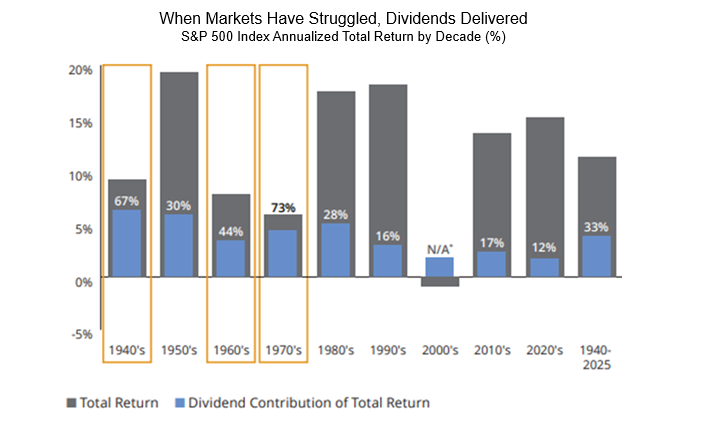
When stock prices stall or decline, dividends often become the unsung heroes of long-term investing. A compelling chart from Hartford Funds (sourced via Morningstar) illustrates this perfectly. It breaks down the S&P 500 annualized total return by decade from the 1940s through the mid-2020s, highlighting the dividend contribution to overall returns.
The data reveals a clear pattern, in challenging decades with low or negative price growth, dividends provided the majority of investor gains. In stronger growth periods, they played a supporting but still valuable role. This historical perspective underscores why dividend-paying stocks remain a cornerstone of resilient portfolios.
S&P 500 Total Returns by Decade: Dividends Step Up When Needed
- 1940s: Total return of approximately 10%, with dividends contributing 67% – during a turbulent post-Depression and wartime era where payouts delivered most of the gains.
- 1950s: Strong total return of approximately 20%, dividends contributed about 30% – booming growth meant capital appreciation dominated.
- 1960s: Modest total return of approximately 8%, dividends about 44% – slower price gains elevated the role of income.
- 1970s: Total return of approximately 7%, dividends a massive 73% – high inflation and stagflation made reliable payouts essential.
- 1980s: Robust total return of approximately 18%, dividends about 28% – bull market driven by falling rates and economic recovery.
- 1990s: Stellar total return of approximately 18%, dividends only about 16% – tech boom focused on growth over income.
- 2000s (the “Lost Decade”): Negative total return (price losses from dot-com bust and financial crisis), yet dividends delivered a positive 1.8% annualized return -proof that dividends can turn a down decade into one with real income.
- 2010s: Strong total return of approximately 14%, dividends about 17% – recovery and low rates fueled appreciation.
- 2020s (through mid-period): Solid total return of approximately 15% – dividends 12% range in partial data.
- Overall – 1940–2025: Dividends accounted for about 33% of cumulative total return – a steady, compounding force.
What Is Total Return and Why Dividends Matter So Much?
Total return measures an investment’s full performance over time, combining price appreciation (or depreciation) with reinvested dividends and other distributions. While headlines focus on index levels, true long-term wealth building comes from both components.
Historically, dividends have averaged 30–40% of S&P 500 total returns over extended periods (closer to 33% from 1940 onward in this dataset). In “lost” or low-return decades, that share surges because dividends provide tangible cash flow even when share prices struggle. Reinvesting those dividends compounds powerfully over time, turning modest income into significant growth.
Why This Historical Data Is Relevant for Today’s Investors
Markets remain unpredictable, volatility from inflation, interest rates, geopolitics, or recessions can suppress price gains for years. The chart reminds us:
- Income stability – Dividends offer reliable cash flow, independent of daily price swings.
- Downside protection – As seen in the 2000s, dividends delivered positive returns during a negative decade for the index.
- Compounding advantage – Reinvested dividends buy more shares at lower prices during dips, accelerating recovery.
- Inflation hedge – Many strong companies grow dividends over time, helping preserve purchasing power.
In an environment where high-growth tech stocks dominate headlines, focusing solely on capital appreciation can leave portfolios vulnerable. Dividend-focused strategies, whether through individual stocks, ETFs tracking Dividend Aristocrats, or broad dividend indexes have historically provided ballast when broad markets faltered.
The Bottom Line on S&P 500 Dividends and Long-Term Performance
The S&P 500’s decade-by-decade history proves one timeless truth: dividends deliver, especially when markets struggle. From the inflationary 1970s to the “lost” 2000s, they’ve turned flat or negative periods into sources of real return. For investors building wealth over decades, ignoring dividends means overlooking a proven, compounding engine of total return.
Whether you’re planning for retirement income, seeking portfolio stability, or simply aiming for better risk-adjusted results, history shows that S&P 500 dividends deserve a central role in your longer-term strategy. At Landmark, we have adopted this philosophy, particularly in the case of retiree’s who depend on their portfolio for current cash flow needs.
About the Author
Joseph M. Favorito, CFP® is a Certified Financial Planner® as well as the founder and managing partner at Landmark Wealth Management, LLC, a fee-only SEC registered investment advisory firm. He specializes in helping individuals and families develop comprehensive financial strategies to achieve their long-term goals.